
 +382 60 099359


Herceg Novi sits at the entrance to the Bay of Kotor, and nearly everything that draws visitors to this historic Montenegrin town is concentrated on the hillside between the sea and the Adriatic Highway. Founded in 1382 by Bosnian King Tvrtko I, the town later came under Ottoman, Venetian, and Austrian rule, with each era leaving its mark through fortresses, towers, and religious landmarks. As a result, the answer to what to see in Herceg Novi is refreshingly straightforward: the Old Town and its Clock Tower, two historic fortresses—Kanli Kula and Forte Mare—Savina Monastery, and the Pet Danica Promenade with Škver Harbour.
All five attractions can be explored on foot in a single day. However, allow 6–8 hours for a relaxed visit, rather than expecting to squeeze everything into a couple of hours between trips to the beach. The main reason is the terrain. Herceg Novi is often called the City of Stairs, and exploring the area between the waterfront and the upper Old Town involves climbing several dozen metres uphill. Comfortable shoes with non-slip soles are more important than a camera: centuries of foot traffic have polished the old stone steps, making them particularly slippery after rain.
Top 5 Attractions in Herceg Novi: Map and Visitor Information
The five attractions are spread across Herceg Novi’s historic centre and eastern waterfront. Three landmarks—the Clock Tower, Kanli Kula Fortress, and Forte Mare Fortress—are close together in the Old Town, but steep streets and stairways make the walking routes more demanding than the distances suggest. Škver Harbour, directly below Forte Mare, is a convenient starting point for the Pet Danica Promenade. Savina Monastery lies approximately 2 km east of the historic centre, with an uphill approach from the waterfront. The interactive map in this section marks all five sightseeing stops, using Škver Harbour as the reference point for the promenade. Check the walking directions before setting out, particularly if you want to avoid steep climbs.
| Attraction | Main Highlights | Suggested Visit Duration | Admission | Physical Effort |
|---|---|---|---|---|
| Old Town and Clock Tower | Historic gateway dating from 1667, Belavista Square, Church of Archangel Michael | 1–1.5 hours | Free | Moderate: steps and sloping streets |
| Kanli Kula Fortress | Highest point in the historic centre, open-air summer amphitheatre, panoramic town views | 40–60 minutes | €4 individual; €3 per person for groups of 10+ | Moderate: uphill climb and steps |
| Forte Mare Fortress | Historic seaside fortress overlooking the harbour, open-air summer cinema | 40–60 minutes | €4 individual; €3 per person for groups of 10+ | Moderate: steps within the fortress |
| Savina Monastery | Three churches, Baroque iconostasis, peaceful gardens | 45–75 minutes | Free entry to the grounds; voluntary donations welcome | Moderate: uphill walk from the waterfront |
| Pet Danica Promenade and Škver Harbour | Seafront walking route, boats, beaches, cafés | 30 minutes–2 hours | Free | Easy: mostly level waterfront promenade |
If you are short on time, focus on the Old Town and one of the fortresses. In just 1.5–2 hours, you can explore the historic gateway, visit Belavista Square, and enjoy sweeping views across the Bay of Kotor.
History enthusiasts should make time for Savina Monastery, the oldest and one of the least tourist-oriented landmarks in this selection. For a more leisurely experience without strenuous climbing, simply follow the waterfront promenade from Škver Harbour in either direction.
1. Herceg Novi Old Town and the Clock Tower
Herceg Novi’s historic centre is compact but spread across several levels. At the lower end lies Nikola Đurković Square, with the gateway beneath the Clock Tower leading up to Belavista Square above. The Clock Tower (Sahat Kula), built in 1667 during Ottoman rule, is known locally as Tora. Standing above the former main entrance to the town, it remains the most recognisable gateway into Herceg Novi’s Old Town.
Passing beneath the archway and climbing the steps brings you to Belavista Square, officially known as Trg Herceg Stjepana. At its centre stands the Church of St. Archangel Michael, constructed between 1883 and 1905 using pale stone from the island of Korčula and consecrated in 1911. Its architecture combines Byzantine foundations with Romanesque-Gothic and Oriental influences. Above the entrance, a mosaic depicting the Archangel Michael sits alongside a distinctive rose window. Nearby is an old fountain that once served as one of the town’s water sources.
From Belavista Square, narrow lanes branch off between stone houses, passing beneath archways and descending towards the sea via flights of steps. Following these streets, you can reach the Church of St. Jerome and continue towards Forte Mare Fortress. Exploring the Old Town is completely free: this is a living residential neighbourhood, not an open-air museum with an admission fee.

What to look out for along the way:
- The coat of arms and clock on the tower, viewed from the lower square — one of the best angles for photographs.
- The historic fountain on Belavista Square and the side façades of the Church of St. Archangel Michael.
- The pedestrian section of Njegoševa Street, which approaches the Clock Tower from the west.
- The stepped alleyways between Belavista Square and the sea — the very feature that helped give Herceg Novi its distinctive nickname.
Visitor Information
- Location: Lower part of the historic centre, Trg Nikole Đurkovića (Nikola Đurković Square).
- Map location: Sahat Kula, Herceg Novi.
- How to get there: From the bus station, walk downhill through the streets towards the town centre. From the waterfront, climb the steps leading up from Škver Harbour.
- Walking time: Approximately 10–15 minutes from either the bus station or Škver Harbour.
- Admission: Free.
- Opening hours: The Old Town is a public urban area accessible 24 hours a day. Check individual church opening hours locally.
- Recommended visit duration: 1–1.5 hours.
- Best time to visit: Before 10:00 a.m., when the morning light is soft on the Clock Tower and the streets are relatively quiet. In the evening, the square takes on a livelier atmosphere.
- Accessibility: There are steps beneath the archway and throughout the Old Town. Access with a stroller is limited, while older visitors may prefer to take their time and choose routes with gentler gradients.
- Best suited for: First-time visitors, photographers, and architecture enthusiasts.
Start your walk at the lower level, on Nikola Đurković Square, rather than at Belavista. This way, you enter through the historic gateway in the traditional order and only have to make the uphill climb once. If you are travelling with older family members, consider taking a taxi to the upper part of the historic centre and exploring the Old Town downhill instead.
2. Kanli Kula Fortress
Kanli Kula is the highest point in Herceg Novi’s historic centre and the largest of the city’s fortresses. It was built by the Ottomans after 1539, while the Venetians, who captured the town in 1687, subsequently reconstructed and reinforced its defensive walls. Its name translates from Turkish as “Bloody Tower”, a reference to its long history as a prison. Prisoners left drawings on the walls of the lower chambers, including depictions of 16th- and 17th-century galleys, which have helped historians establish when the fortress was used for incarceration.
A more detailed account of its history can be found on the official Herceg Novi Tourism Organisation’s Kanli Kula page.
In the 1960s, the fortress courtyard was transformed into an open-air amphitheatre with seating for approximately 1,000 spectators. Today, it hosts summer concerts, theatrical performances, film festival screenings, and other musical and cultural events. During the day, visitors can see the rows of seats and the stage, although the fortress may be closed to regular sightseeing in the evening when events are scheduled.
There is no extensive museum exhibition inside the fortress. The main attractions are its historic walls, bastions, and panoramic views. From the fortifications, you can look out over the terracotta rooftops of the Old Town, the dome of the Church of St. Michael the Archangel, and the harbour, with the Luštica Peninsula and the entrance to the Bay of Kotor stretching into the distance. The chambers containing the prisoners’ graffiti are not always open to visitors, so ask at the ticket office if you would like to see them.

Visitor Information
- Location: The northern, upper section of Herceg Novi’s Old Town, close to the Adriatic Highway.
- Map location: Kanli Kula Fortress, Herceg Novi.
- How to get there: From Belavista Square, follow the narrow streets uphill. From the bus station, walk downhill towards the Old Town; the fortress is almost directly along the way.
- Walking time: Approximately 5–10 minutes uphill from the Clock Tower.
- Admission: €4 per person, or €3 per person for organised groups of 10 or more, according to JUK Herceg Fest’s published 2026 rates.
- Opening hours: The fortress operates on a seasonal schedule. From 15 April 2026, the published hours were 9:00 a.m.–7:00 p.m. daily, with extended opening during the summer and shorter hours in winter. Check the latest schedule on the official [JUK Herceg Fest website](https://www.hercegfest.me/), as concerts and other events may affect sightseeing access.
- Recommended visit duration: 40–60 minutes.
- Best time to visit: In the morning or around 1.5–2 hours before sunset, when the sunlight illuminates the town rather than shining directly into your camera lens.
- Accessibility: Reaching and exploring the fortress involves stairs and uneven stone surfaces, making it unsuitable for most wheelchairs and difficult to navigate with pushchairs.
- Best suited for: History enthusiasts, photographers, and visitors attending summer concerts.
Check the events calendar before visiting Herceg Novi’s fortresses. On concert and festival days, Kanli Kula may close to sightseeing visitors earlier than usual. In the evening, admission may be restricted to holders of tickets for the scheduled event.
For the most impressive panoramic photographs, head to the western bastion in the late afternoon or early evening. If you are planning to attend a concert, book your tickets in advance, as popular summer performances at the amphitheatre can sell out.
3. Forte Mare Fortress
Forte Mare, meaning “Sea Fortress,” stands on a rocky promontory directly above Herceg Novi’s harbour. According to tradition, King Tvrtko I laid the first foundation stone here when he founded the town in 1382. The fortifications developed gradually between the 14th and 17th centuries, while the fortress acquired much of its present appearance following Austrian reconstruction in 1833. The different stages of its construction are described on the official Forte Mare website.
While Kanli Kula protected the town from attacks by land, Forte Mare guarded the sea and controlled access to the harbour. This defensive role becomes immediately apparent when you visit. From the upper terrace, you can look down at the boats moored in Škver Harbour, follow the waterfront promenade, and enjoy sweeping views towards the Luštica Peninsula and the narrow passage leading into the Bay of Kotor. Below the fortress, partially submerged in the sea, lie the remains of the Venetian Citadel, which was destroyed in the 1979 earthquake.
Forte Mare is also a cultural venue, with an open-air cinema established in the 1950s and a longstanding connection to Herceg Novi’s film events. During the summer, screenings and other performances can change the usual sightseeing arrangements, particularly in the evening. Visitors should check the current programme with JUK Herceg Fest before arriving. Outside scheduled events, the fortress’s main attractions are its historic stonework, elevated terraces, and views over Škver Harbour and the entrance to the Bay of Kotor.
Why both fortresses are worth visiting: Kanli Kula stands higher above the town, offering panoramic views across Herceg Novi, with its impressive theatrical stage at the centre of the fortress. Forte Mare, by contrast, faces the sea and is particularly rewarding for its views of the harbour and the entrance to the bay. The two fortresses complement one another rather than offering interchangeable experiences.
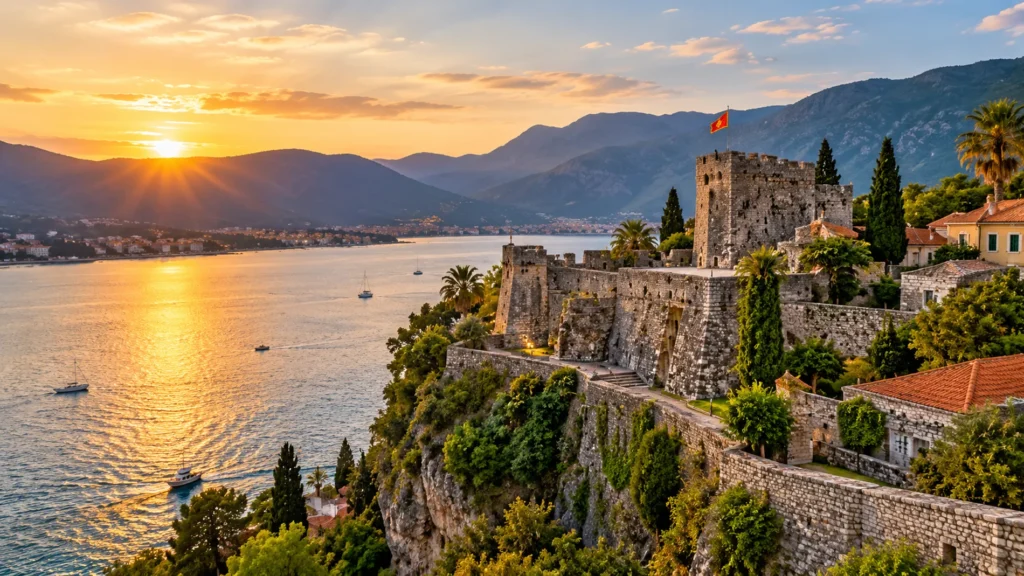
What to look out for at the fortresses:
- The seaward gates and the different layers of historic stonework at Forte Mare, revealing successive periods of construction and reconstruction.
- The remains of the Venetian Citadel, visible in the water below Forte Mare.
- The stage and tiered amphitheatre seating at Kanli Kula, whose impressive scale is striking even when no performance is taking place.
- The direction of the wind and the position of the sun, as the exposed fortress walls offer very little shade.
Visitor Information
- Location: At the southern edge of Herceg Novi’s Old Town, on a rocky outcrop overlooking Škver Harbour.
- Map location: Forte Mare Fortress, Herceg Novi.
- How to get there: From the Old Town, follow the steps downhill from Belavista Square. From the harbour, climb the steps leading up from the waterfront promenade.
- Walking time: Approximately 5–10 minutes downhill from Belavista Square, or around 5 minutes uphill from Škver Harbour.
- Admission: €4 per person for individual sightseeing visits, or €3 per person for groups of 10 or more, according to the official 2026 tariff published by JUK Herceg Fest. Tickets for concerts and film screenings are priced separately.
- Opening hours: Seasonal hours apply. From 15 April 2026, regular visits were scheduled daily from 9:00 a.m. to 7:00 p.m., with longer hours during the summer season. The fortress is also used for concerts and film festival screenings, which may change public access. Confirm the latest visiting hours through [JUK Herceg Fest](https://www.hercegfest.me/) before travelling.
- Recommended visit duration: 40–60 minutes.
- Best time to visit: In the morning, when the light illuminates the harbour, or shortly before sunset.
- Accessibility: Numerous steps and uneven stone surfaces make the fortress unsuitable for wheelchairs and pushchairs.
- Best suited for: Photographers, families with school-age children, and anyone who enjoys spectacular coastal views.
The most practical route is to visit Kanli Kula first, then walk downhill through the Old Town to Forte Mare before continuing down to the waterfront. This way, you only have to tackle one significant uphill climb, with the rest of the walk following the natural slope towards the sea.
4. Savina Monastery
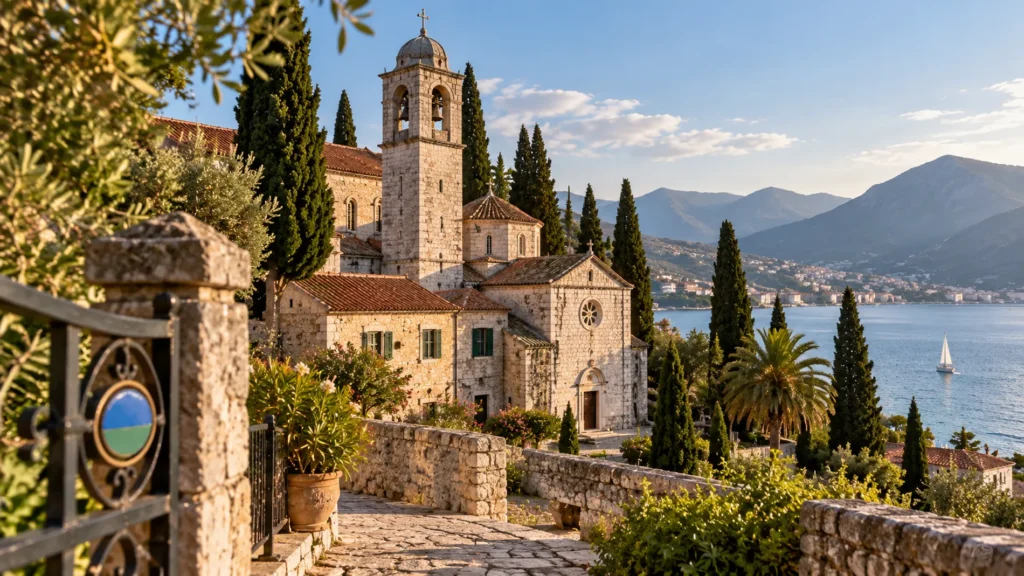
Savina Monastery is located approximately 2 km east of Herceg Novi’s Old Town, on a hillside surrounded by Mediterranean greenery overlooking the sea. It is an active Serbian Orthodox monastery rather than a museum, and the atmosphere here is noticeably more peaceful than in the town centre. Details about the monastery, its history, and its location can be found on the official Herceg Novi Tourism Organisation website.
The Savina Monastery complex includes three churches, although the Church of St. Sava stands separately on a wooded hillside above the main monastery buildings. The Small Church of the Dormition of the Mother of God is traditionally associated with the year 1030, a date recorded in a much later inscription from 1831. Its precise origins remain uncertain, and architectural evidence points to substantial construction or reconstruction during the 15th century. The oldest surviving frescoes are also associated with that period and show stylistic connections to the work of Kotor painter Lovro Dobričević. These distinctions are explained by the Herceg Novi Tourism Organisation.
The Great Church of the Dormition was built between 1777 and 1799 by Nikola Foretić, a master builder from the island of Korčula. Its most important artistic feature is a Baroque iconostasis painted by Simeon Lazović and his son between 1795 and 1797.
The monastery flourished after 1693, when monks from the destroyed Tvrdoš Monastery in Herzegovina relocated here. Its treasury contains Russian, Greek, and Italo-Cretan icons, manuscripts, early printed books, and liturgical objects. Access to the collection depends on the monks and the schedule of religious services, so do not assume that a visit to the treasury will be possible.
From the area near the monastery gates, visitors can enjoy sweeping views across the bay towards the Luštica Peninsula and Topla. The scenery is particularly beautiful in the soft morning light.
Visitor Information
- Location: Savina neighbourhood, approximately 2 km east of the Old Town.
- Map location: Manastir Savina, Manastirska 21, Herceg Novi.
- How to get there: Walk east along the seafront promenade, then follow the uphill route to the monastery. Alternatively, take a taxi directly to the entrance.
- Travel time: Approximately 25–35 minutes on foot from Škver Harbour, or just a few minutes by taxi.
- Admission: Based on available information, there is no separate admission fee for entering the monastery grounds. Donations are welcome. Ask on arrival about access to the treasury.
- Opening hours: The grounds are generally accessible during daylight hours. Access to the churches may be restricted during religious services.
- Recommended visit duration: 45–75 minutes, or longer if you also plan to visit the Church of Saint Sava.
- Best time to visit: In the morning, when temperatures are cooler and there are fewer tour groups.
- Accessibility: The walk up from the waterfront involves a slope and steps. Some paths within the monastery grounds are relatively level, while a trail leads to the Church of Saint Sava.
- Best suited for: History and art enthusiasts, pilgrims, and visitors looking for a peaceful retreat.
Visitors should wear clothing that covers their shoulders and knees. Women are encouraged to bring a headscarf. Avoid taking photographs inside the churches without permission, and keep your voice low out of respect for the religious setting.
After exploring the monastery, you can walk downhill towards the sea and return to the town centre along the waterfront promenade.
5. Pet Danica Promenade and Škver Harbour
Šetalište Pet Danica is Herceg Novi’s main waterfront promenade. It was named in memory of five young women, all named Danica, who lost their lives during the Second World War.
The promenade follows the route of a former railway line that once connected the coast with Sarajevo. As a result, sections of the walkway pass through short tunnels cut into the coastal rock.
The promenade stretches approximately 5–7 km, depending on the source and the exact starting and finishing points, running from Igalo to Meljine. However, visitors exploring Herceg Novi’s main attractions do not need to walk its entire length.
A convenient starting point is Škver Harbour, located directly below Forte Mare Fortress. Fishing boats and pleasure craft fill the small harbour, which is also home to a monument to King Tvrtko.
During the summer, boat excursion operators offer trips from the harbour to Mamula Island, the Blue Cave, and beaches along the Luštica Peninsula.
From Škver, you can choose between two pleasant walking routes:
- West towards Topla: A relatively short walk of 15–20 minutes each way, passing waterfront cafés, concrete swimming platforms, and a tunnel between Škver and Topla.
- East towards Savina: A quieter, greener route taking approximately 25–35 minutes, ending near the uphill path to Savina Monastery.
Access to the promenade itself is free. You will only need to pay for optional services such as food and drinks at cafés, sun loungers and umbrellas provided by beach operators, boat rentals, and organised excursions.
It is worth understanding the distinction: the promenade is a public pedestrian walkway, while many of the equipped swimming platforms are operated by private businesses.

Visitor Information
- Location: Along Herceg Novi’s coastline, with a convenient starting point at the harbour below Forte Mare Fortress.
- Map location: City Port Škver, Herceg Novi.
- How to get there: Follow the stairways downhill from Forte Mare or Belavista Square.
- Travel time: Approximately 5 minutes from Forte Mare and 10–15 minutes from the Clock Tower.
- Admission: Free. Cafés, sun loungers, and boat excursions are charged separately.
- Opening hours: The promenade is an open public space.
- Recommended visit duration: 30–40 minutes for a short walk, or up to 2 hours if you plan to stop for refreshments or swimming.
- Best time to visit: Sunset offers beautiful light over the boats and Luštica Peninsula, while mornings tend to be quieter and cooler.
- Accessibility: This is the flattest and easiest walking section of the itinerary, making it suitable for visitors with pushchairs. However, reaching the promenade from the Old Town involves descending stairs.
- Best suited for: Families with children, couples, and anyone looking for a relaxing break from Herceg Novi’s steep streets.
A walk along the promenade is not the same as spending a full day at the beach. Most swimming areas here consist of pebble beaches or concrete platforms, and the best spots tend to fill up early during the summer. If swimming is your main priority, choose a specific beach in advance.
Travellers with limited mobility may find it more convenient to take a taxi to the promenade from the Igalo or Topla side, avoiding the steep stairways leading down from the Old Town.
One-Day Herceg Novi Itinerary
The most practical way to explore Herceg Novi in a day is to organise your route around the town’s steep terrain, minimising unnecessary uphill walking.
Start at Kanli Kula Fortress, at the upper edge of the historic centre, then work your way downhill through the Old Town towards the sea. From there, follow the relatively level waterfront promenade towards Savina.
This means slightly rearranging the traditional sightseeing order: instead of beginning at the Clock Tower, you start at the upper fortress and pass the tower on your way down.
If you are staying near the waterfront, you can reverse the route. However, doing so means tackling the steepest climb in the middle of the day, when temperatures may be considerably higher.
The order of stops may need to change depending on fortress opening hours, weather conditions, local events, and the location of your accommodation. The main principle is to schedule the most demanding uphill sections during the cooler hours.
| Stage | What to Visit | Recommended Time | Walk to the Next Stop |
|---|---|---|---|
| 1. Morning | Kanli Kula Fortress | 40–60 minutes | 5–10 minutes downhill |
| 2. Late morning | Belavista Square, Church of Archangel Michael, Clock Tower | 1–1.5 hours | 5–10 minutes downhill |
| 3. Before lunch | Forte Mare Fortress | 40–60 minutes | 5 minutes downhill |
| 4. Lunch and relaxation | Škver Harbour, waterfront cafés | 1–1.5 hours | 25–35 minutes east on foot |
| 5. Afternoon | Savina Monastery | 45–75 minutes | Return along the promenade or take a taxi |
Allow 6–8 hours for the complete itinerary, including lunch and time to enjoy the surroundings without rushing.
During the hottest months, consider taking a longer break by the sea between your visit to Forte Mare and the walk towards Savina Monastery.
Shorter Herceg Novi Itinerary: 3–4 Hours
If you have limited time, you can still experience the highlights of the historic centre and waterfront by following this shorter route:
- Kanli Kula Fortress: Walk up to the fortress and explore it if it is open. If it is closed, admire the exterior and surrounding views.
- Belavista Square and the Clock Tower: Explore the square, admire the Church of Archangel Michael, and descend through the historic streets beneath the Clock Tower.
- Forte Mare Fortress: Visit the fortress if you have approximately an hour to spare. Otherwise, enjoy the viewpoint near its walls before continuing downhill.
- Škver Harbour and the Topla waterfront: Finish at the harbour with a short stroll west towards Topla. On this shorter itinerary, it is best to skip Savina Monastery or save it for the following day.
Budget and Practical Tips

Many of Herceg Novi’s most memorable attractions are free to explore. You can wander through the Old Town, visit its historic squares, stroll along the waterfront, and explore the monastery grounds without purchasing a ticket. The main sightseeing expenses are admission fees to the city’s two fortresses.
Fortress opening hours vary by season, and summer schedules may be affected by concerts and film screenings, so always check opening times on the day of your visit. During the off-season, from November to March, the fortresses may operate on reduced schedules. On the other hand, the town is quieter, and February brings the colourful Mimosa Festival, one of Herceg Novi’s best-known annual celebrations.
| Expense | Is Payment Required? | Estimated Cost or Reference | What to Check |
|---|---|---|---|
| Kanli Kula Fortress admission | Yes, to enter the fortress | €4 individual; €3 per person for groups of 10+ | Opening hours, scheduled events |
| Forte Mare Fortress admission | Yes, to enter the fortress | €4 individual; €3 per person for groups of 10+ | Opening hours, available discounts |
| Savina Monastery | No | Donations are optional | Access to the treasury |
| Boat trip from Škver Harbour | No, optional activity | Prices vary by operator at the harbour | Itinerary, what’s included, weather conditions |
| Sun lounger and umbrella | No, optional | Prices set by individual beach operators | Whether a free public beach area is available |
| Taxi to Savina | No, optional | Metered fare or an agreed price | Confirm the fare before departure |
What to bring when exploring this town of stairways:
- Comfortable shoes with non-slip soles rather than flip-flops, especially for steep steps and polished stone streets.
- Plenty of drinking water. The fortress walls offer little shade, and summer temperatures can become uncomfortable by midday.
- A sun hat and sunscreen to protect yourself during exposed walks.
- A scarf or lightweight cover-up for visiting the monastery.
- Small euro banknotes and coins for admission fees and voluntary donations.
Where to Stay for Easy Sightseeing
Where you stay in Herceg Novi can make a considerable difference to how many stairs you climb each day.
Accommodation near the Old Town is particularly convenient for evening visits to the fortresses and exploring the historic centre. However, reaching the waterfront involves walking downhill, followed by a climb back up. Parking is also limited in the central area.
Staying along the waterfront between Škver and Topla gives you easy access to the sea and a relatively flat promenade for leisurely walks. However, visiting Kanli Kula Fortress still involves a noticeable uphill climb.
Savina is a peaceful, leafy neighbourhood close to the monastery and the eastern section of the waterfront promenade. The town centre is approximately a 30-minute walk away, making it a good option for visitors who prefer quieter surroundings without being too far from the main attractions.
Igalo, to the west, offers flatter terrain, beaches, and well-established resort facilities. It is particularly convenient for relaxed seaside holidays, although reaching the Old Town on foot takes longer.
There is no single best neighbourhood for every visitor. Families travelling with pushchairs may find waterfront accommodation more practical, while those who enjoy evening strolls through historic streets will appreciate staying in the Old Town.
If you are considering Herceg Novi for an extended stay or relocation, our guide to local lifestyle, beaches, infrastructure, and real estate offers a closer look at everyday life beyond the tourist attractions. If you are exploring more of the Bay of Kotor, you may also find our destination guides to Kotor, Perast, and Tivat useful when planning your trip. These nearby towns offer different combinations of historic architecture, waterfront walks, and coastal scenery.
Planning a longer stay in Herceg Novi or considering property on the Montenegrin coast? The choice between the Old Town, Topla, Igalo, and Savina can significantly affect your daily routine, access to the waterfront, and parking options. World Estate Homes helps buyers compare properties according to location, budget, and intended use. Start with our personalised property selection questionnaire to narrow down the options that best match your priorities.
Final Thoughts
What makes Herceg Novi so appealing is the remarkable variety of attractions concentrated along a relatively short stretch of coastline. The Old Town reveals layers of Ottoman and Austro-Hungarian history, Kanli Kula offers the finest panoramic views and a spectacular setting for evening performances, Forte Mare overlooks the harbour and the entrance to the Bay of Kotor, Savina Monastery provides a peaceful retreat and some of the region’s oldest frescoes, while the Pet Danica Promenade connects it all to the sea.
For a first visit, prioritise the Old Town, one of the fortresses, and a walk along the waterfront. If you have a full day, add the second fortress and Savina Monastery to your itinerary. Ideally, though, spread your sightseeing over two days. Herceg Novi is a town of stairways and steep streets, and its true charm emerges when you explore at an unhurried pace, leaving plenty of time to enjoy the sea between climbs.
 Real estate in Georgia
 Real estate in Cyprus
 Real estate in the UAE
 Real estate in Bali
 Real estate in Thailand
 Real estate in Spain
 Real estate in Saudi Arabia
 Real estate in Turkey
 Real estate in Zanzibar
 +382 60 099359
 hello@residence-estate.me
 The Old Bakery Residences, Budva 85310, Montenegro


 Get catalogue of TOP-7 objects