
 +382 60 099359




Buying property in Montenegro does not grant residence automatically. What registered ownership can do — provided certain conditions are met — is create a legal basis to apply for a one-year temporary residence permit through the Ministry of the Interior of Montenegro. Following amendments to the Law on Foreigners that entered into force in January 2026, most third-country nationals must own property whose taxable base reaches at least €150,000. Beyond that threshold, applicants must still satisfy general residence requirements: a valid passport, proof of sufficient means, health insurance and a registered local address, among other documents. The permit is not a golden visa, does not confer citizenship and does not automatically include the right to work.
This article covers the current eligibility rules, how the value threshold is measured, which properties and ownership shares qualify, the complete application process from property selection to permit card, renewal obligations, family arrangements, costs, rights and limitations, and what property-based temporary residence means — and does not mean — for long-term settlement prospects. Where official sources do not specify an exact figure or procedure, that uncertainty is noted and readers are directed to confirm details locally.
Buying qualifying property creates a legal basis to apply for temporary residence; it does not grant residence automatically.
Quick Answer
Property-based residence in Montenegro is a temporary residence permit (locally referred to as boravak) issued for one year and renewable annually. It is not a separate investment programme or golden visa — it is one of several legal grounds for temporary residence listed in the Law on Foreigners.
The process requires that ownership is registered in the cadastre before an application can be submitted. Signing a reservation form or paying a deposit is not sufficient. Once ownership is registered, the applicant must obtain the real estate transfer tax decision issued by the competent authority, because the €150,000 threshold is measured against the taxable base stated in that document — not the contract price alone.
An initial application may be submitted personally to the Ministry of Interior or, where the Ministry’s electronic system is operational for the relevant application type, electronically. Under Article 61b, an applicant using the electronic route must report to the Ministry at the place of stay within ten days after entering Montenegro so that a photograph, two fingerprints and a digitised signature can be collected. Renewal applications are submitted in person under Article 64 and are not eligible for the electronic procedure. No automatic approval follows from meeting the property threshold; the Ministry assesses whether the applicant satisfies the statutory conditions and whether any legal ground for refusal applies. The permit does not include an automatic right to work. Montenegro is not an EU or Schengen member as of August 2026, so the permit confers no Schengen residence rights.
The previous citizenship-by-investment programme that ran until 31 December 2022 has been discontinued and is entirely separate from property-based temporary residence.
| Question | Current position |
|---|---|
| Does property ownership qualify as a ground? | Yes, if conditions are met |
| Minimum value document | Taxable base of at least €150,000 in the real estate transfer tax decision, where this requirement applies; VAT-treated acquisitions require separate written confirmation from MUP |
| Which value is used? | Taxable base in the real estate transfer tax decision, not necessarily the contract price |
| Permit term | One year |
| Renewable? | Yes, annually, subject to conditions |
| Automatic approval? | No |
| Right to work? | Not automatically included |
| Schengen residence? | No — Montenegro is not a Schengen member |
| Direct citizenship route? | No |
The table above reflects the rules in force as of August 2026. Applicants should verify current requirements directly with the competent Ministry of Interior office before submitting.
Key Numbers at a Glance
| Requirement | Current rule |
|---|---|
| Minimum taxable base | €150,000 |
| Minimum ownership share | 50% |
| Residence permit validity | 1 year |
| Renewal application window | 60–30 days before expiry |
| MUP decision period | Up to 40 days (Article 62) |
| Permit may cease after absence | More than 30 days (Article 65) |
| Permanent residence continuity | Max. 10 months total or 6 consecutive months outside Montenegro (Article 86) |
The statutory references in this table are drawn from the current consolidated Law on Foreigners. Because some older English-language government pages have not been updated consistently, the consolidated legal text should be checked before relying on any long-term immigration strategy.
What Changed in 2026
For several years, Montenegro had no statutory minimum property value for temporary residence based on real estate ownership. That changed through amendments to the Law on Foreigners which entered into force in January 2026.
In the period leading up to the amendments, government consultations and media coverage referenced a range of possible thresholds, including a figure of €200,000 that appeared in some early preparatory materials. The final enacted threshold for most third-country nationals is €150,000, measured against the taxable value of the property. Readers who have encountered older articles citing €200,000 as the confirmed figure should treat those sources as inaccurate or outdated — the operative number in the law as enacted is €150,000.
The €150,000 threshold is determined by the taxable base in the real estate transfer tax decision — not the contract price, the asking price or the annual property-tax amount.
This distinction matters practically. The €150,000 threshold is determined by the taxable base stated in the real estate transfer tax decision issued by the competent authority — it should not be confused with the contract price, the asking price or the annual property-tax amount. A buyer who pays €170,000 for an apartment cannot assume the taxable base in the transfer tax decision will automatically meet the threshold. Equally, a buyer who pays €155,000 should not assume it will be assessed at that level. Because the decisive document is normally issued in connection with the completed transfer, buyers should obtain transaction-specific advice before signing. Any preliminary estimate of the taxable base should be treated only as an estimate and not as confirmation that the statutory threshold will be met.
For EU, EEA and Swiss nationals, the amendments include an exemption from the €150,000 threshold, as discussed below. Holders of temporary residence permits issued before January 2026 may be subject to transitional provisions under the law; those applicants should review the specific provisions of the amendments and confirm the applicable rules with the Ministry of Interior rather than assuming their existing permit renews under the old rules.
Existing Permit Holders
Temporary residence permits issued on the basis of real estate ownership before 17 January 2026 are subject to transitional provisions. Professional analysis of the enacted amendments reports that such permits may be renewed without proving that the property meets the new value threshold. This should not be extended to a first application submitted after that date. Existing permit holders should confirm the documents required for their own renewal with the competent MUP office.
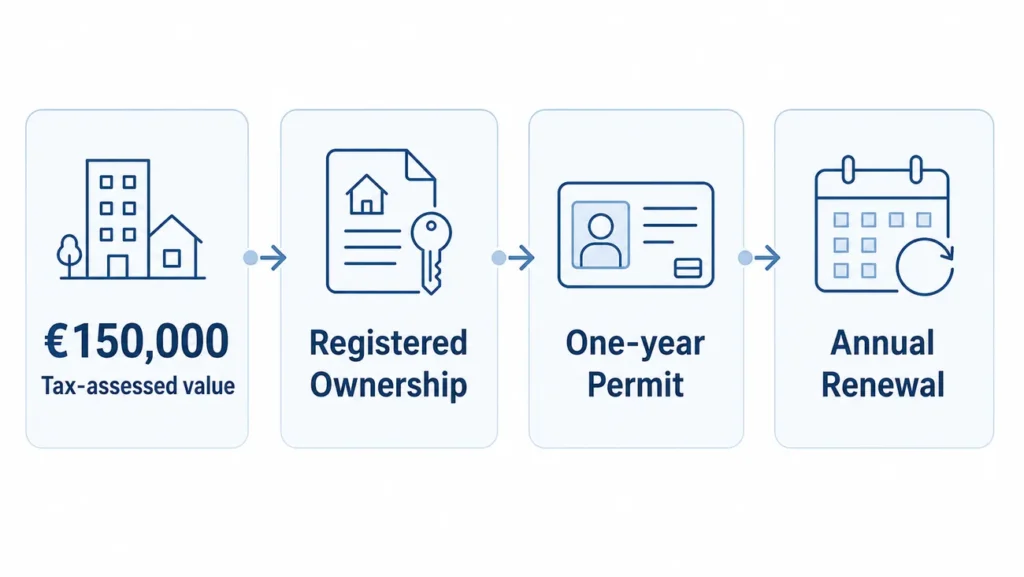
Before and After the 2026 Reform
| Issue | Before 17 January 2026 | Current position |
|---|---|---|
| Minimum property value | No statutory minimum value | Taxable base of at least €150,000 where the requirement applies |
| Evidence of value | No statutory value document required | Real estate transfer tax decision specified by Article 56 |
| Minimum ownership share | Earlier rules did not apply the current threshold in the same form | Sole ownership or a registered share of at least 50% |
| Existing permits | Granted under the previous framework | Transitional rules may apply to permits issued before 17 January 2026 |
| European applicants | No current value exemption in this form | Statutory exemption for specified European nationals and qualifying family members |
Who Can Apply
The primary eligibility criteria for temporary residence based on real estate ownership, as reflected in the Law on Foreigners and confirmed on the Government of Montenegro temporary residence page, are broadly as follows:
- The applicant is a foreign national who owns qualifying real estate in Montenegro
- Ownership is registered in the cadastre in the applicant’s name
- The property or ownership share meets the applicable requirements
- The applicant holds a valid travel document (passport)
- The applicant can demonstrate sufficient means of subsistence for the duration of stay
- The applicant holds valid health insurance covering Montenegro
- The applicant provides a certificate of no serious criminal convictions where required
- The applicant has evidence of secured accommodation in Montenegro and any address-registration document required by the competent Ministry of Interior office
- The applicant does not fall within grounds for refusal under the law
- The application is submitted within the permitted period of stay
The exact document package depends on the applicant’s nationality, age, family situation and the practice of the specific Ministry of Interior office handling the application. Applicants should not rely on a generic checklist as a definitive guide without confirming requirements locally.
On the question of co-ownership: an applicant may rely on sole ownership or a registered co-ownership share of at least one half of a qualifying property. A smaller fractional interest does not meet the statutory ownership requirement under the Law on Foreigners. Whether taxable values across multiple separately owned properties can be aggregated to meet the €150,000 threshold is not clearly confirmed by official sources; applicants considering this approach should seek written confirmation from the competent Ministry of Interior office before purchasing on that basis.
EU and EFTA Exceptions
The value-document requirement does not apply to citizens of EU member states, Iceland, Liechtenstein, Norway and Switzerland, or to qualifying family members covered by the statutory exception under the Law on Foreigners. Family members of such citizens who are themselves third-country nationals should confirm whether they qualify under the family member provisions or whether the standard third-country national conditions apply to their individual situation.
Which Properties Qualify
Not every property transaction in Montenegro produces a qualifying basis for a residence application. The type, legal status and registration of the property all matter.
Completed apartments and houses are the most straightforward option where the property is registered in the cadastre and the applicant’s ownership is properly recorded.
Resale properties can also qualify, provided the title is clean and the taxable base in the real estate transfer tax decision meets the applicable €150,000 threshold.
Completed new builds require extra attention. Once ownership has been transferred and registered, the property may potentially support a residence application. However, Article 56 refers specifically to the taxable base stated in a real estate transfer tax decision.
If the purchase is treated as a VAT transaction rather than a transfer-tax transaction, the standard transfer tax decision may not be issued in the usual form. Before buying a VAT-treated new build for residence purposes, obtain written confirmation from the competent Ministry of Interior office identifying which document it will accept as proof of the €150,000 value requirement.
Registered business premises are included in the statutory list of qualifying property categories. However, ownership of commercial premises does not remove the separate requirement to provide a valid registered address and satisfy the other general residence conditions. The legal character of the registered right — not the commercial use of the space — is what determines eligibility.
Off-plan and unfinished properties cannot support a residence application until a qualifying completed property or registered unit has legally come into existence and the applicant’s ownership has been entered in the cadastre. A reservation agreement, preliminary sale agreement or payment receipt for a future unit does not satisfy the ownership requirement, regardless of its value.
Undeveloped land is not included in the statutory list of qualifying property types under the Law on Foreigners. Purchasing a land parcel, signing a construction contract or planning to build in the future does not create the current property-ownership basis for temporary residence.
Hotel-branded or investment units should be assessed by their registered cadastral status and the legal right actually acquired. A contractual right to income, use or participation in a hotel scheme is not equivalent to registered ownership of a qualifying hospitality facility or separate residential unit. The marketing label matters less than the cadastral classification and the nature of the registered right.
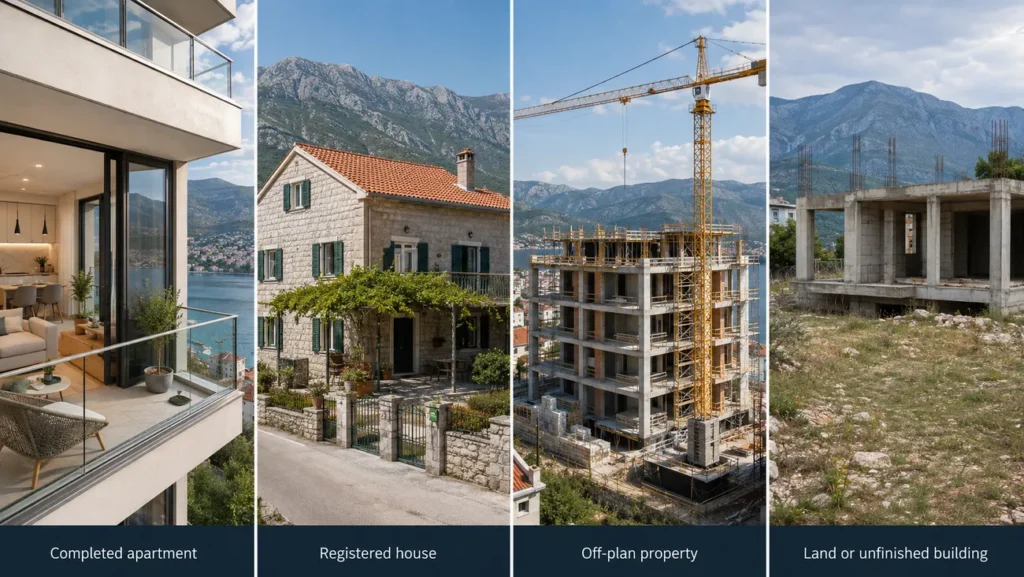
Before paying a non-refundable deposit, check the following:
- Cadastral description: does the cadastral record describe the unit as you expect, and does it match the physical property?
- Registered owner: is the seller actually recorded as the owner in the property sheet (list nepokretnosti)?
- Ownership share: what share of the property does the seller own, and what share will be transferred?
- Encumbrances: are there mortgages, court orders, pre-emption rights or other restrictions registered against the property?
- Legal use and occupancy status: is the property registered for residential or other lawful use, and does it have valid permits?
- Taxable value: what is the current taxable base, and does it meet the €150,000 threshold?
- Outstanding property taxes: are there any unpaid taxes or charges that could delay transfer or affect the buyer?
- Ability to register ownership promptly: are there any pending inheritance proceedings, partition disputes or technical discrepancies that could delay cadastral registration?
A qualified local lawyer can carry out this verification and advise on any issues identified.
Deposit Checklist
| Verify before paying | Why it matters |
|---|---|
| Cadastre | Confirms ownership |
| Encumbrances | Reveals mortgages |
| Ownership share | Confirms eligibility |
| Property category | Must qualify |
| Taxable base | Determines threshold |
| VAT or transfer tax | Determines required document |
| Building permits | Avoids legal issues |
The cadastral record is the authoritative source for ownership and encumbrances in Montenegro. A property that looks clean in a sales brochure may carry undisclosed burdens in the official register. Verifying the list nepokretnosti at the cadastre office — or having a lawyer do so — before committing to a purchase is not optional if the buyer intends to use that property as the basis for a residence application.
Residence eligibility is only one part of the transaction. Buyers should also understand how property selection, legal due diligence, payment, notarisation and cadastral registration work before committing to a purchase.
For the full transaction process, see our guide to how to buy property in Montenegro.
Can I Apply?
| Situation | Eligible? | Notes |
|---|---|---|
| Apartment, taxable base €180,000 | ✅ | Meets threshold |
| Apartment bought for €180,000 but taxable base €145,000 | ❌ | Threshold not met |
| Commercial premises | ✅ | If statutory conditions are met |
| Off-plan apartment | ❌ | Ownership not registered |
| Land only | ❌ | Does not qualify |
| 50% ownership | ✅ | Minimum statutory share |
| 25% ownership | ❌ | Below statutory minimum |
These examples address only the property-related conditions. A “Yes” does not guarantee approval: the applicant must still satisfy the general requirements concerning lawful stay, travel documents, means of subsistence, insurance, accommodation and the absence of statutory refusal grounds. For VAT-treated purchases, written confirmation of the accepted value document remains necessary.
Projects in Montenegro that may interest you


 Bar
Bar от 37,5м²
 Budvaот 63м²
 Barот 30.95м²
 Budvaот 38.52м²
 Budvaот 28м²
 Tivatот 74.24м²
Documents Required
The application for temporary residence based on property ownership typically involves documents from several distinct categories. The list below reflects the generally required items; the specific package for a given applicant should be confirmed with the competent Ministry of Interior office before assembling documents, particularly where foreign certificates are involved.
1. Identity and immigration documents
- Valid passport (with adequate remaining validity)
- Any prior residence permits or visa documentation as applicable
2. Property ownership evidence
- Property sheet (list nepokretnosti) from the cadastre confirming registered ownership
- Real estate transfer tax decision confirming the taxable base used to assess the €150,000 threshold
3. Financial and insurance evidence
- Proof of sufficient means of subsistence; applicants should confirm the current accepted amount and format with the local Ministry of Interior office, as the official sources do not specify a fixed figure
- Valid health insurance policy covering Montenegro for the permit period
4. Supporting and translated documents
- Criminal record certificate issued by the authority required for the applicant’s nationality and residence history, as confirmed by the competent Ministry of Interior office
- Proof of registered address in Montenegro
- Payment receipts for applicable administrative fees
- Certified translations of foreign documents into Montenegrin by a licensed court interpreter
5. Family documents (where dependants are included in a separate family reunification application)
- Marriage certificate or civil partnership documentation
- Birth certificates for minor children
- Evidence of dependency or relationship where applicable
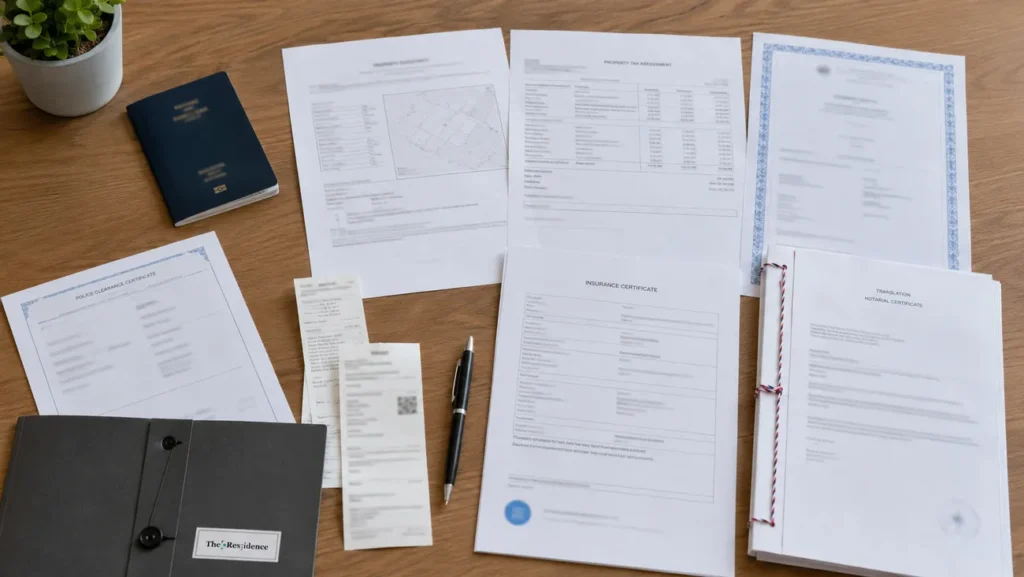
| Document | What it proves | Practical note |
|---|---|---|
| Valid passport | Identity and nationality | Check remaining validity before applying |
| Property sheet / List nepokretnosti | Registered ownership in the cadastre | Obtain a fresh copy close to the application date |
| Real estate transfer tax decision | Taxable base meets €150,000 threshold | Issued by the competent tax authority upon transfer; may differ from contract price |
| Proof of funds | Sufficient means of subsistence | Confirm accepted format and amount locally |
| Health insurance | Medical coverage during permit period | Must be valid for Montenegro; check coverage dates |
| Criminal record certificate | No disqualifying convictions | Check validity period before ordering from abroad |
| Address registration | Physical address in Montenegro | Must be registered before application |
| Payment receipts | Administrative fees paid | Keep originals and copies |
| Family certificates | Relationship to dependants | Required for family reunification applications |
Several practical points deserve attention. Foreign public documents may require an apostille or consular legalisation unless an applicable bilateral or multilateral agreement removes that requirement for documents from a particular country. Certified translation into Montenegrin by a licensed court interpreter is generally required for documents not issued in the local language. Criminal record certificates from some countries expire quickly — check the validity period of your country’s certificate before ordering, and time the request so it remains valid on the application date. Name consistency across all documents is essential; discrepancies in the spelling or transliteration of the applicant’s name can cause delays or requests for additional evidence.
Request an applicant-specific document list from the local Ministry of Interior office before ordering certificates abroad.
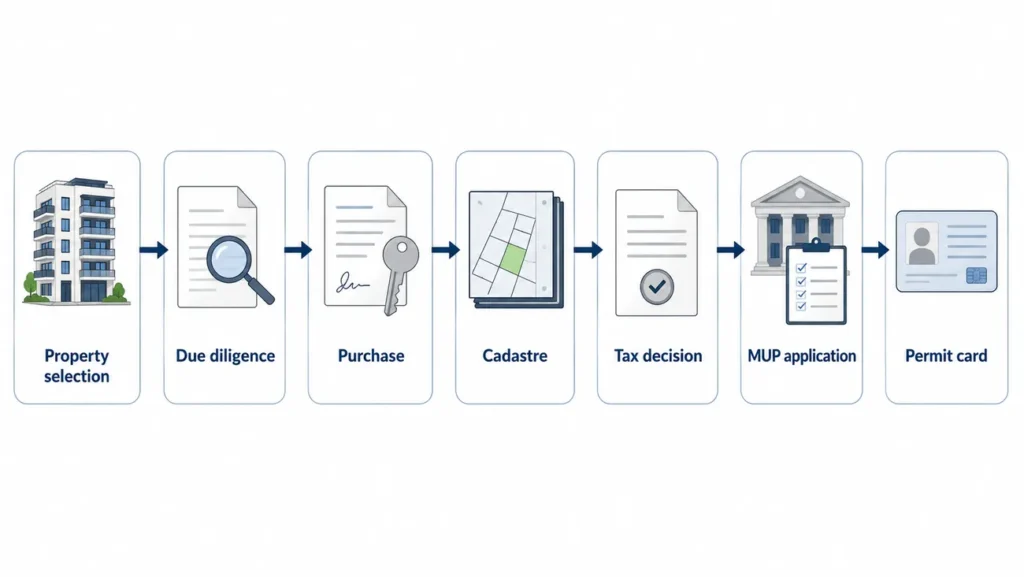
From Property Search to Residence Card
The property purchase and the residence application are two connected but legally separate processes. The residence stage can begin only after the qualifying ownership has been registered and the applicant has obtained the documents required to prove both ownership and the applicable property value.
Property Selection
↓
Purchase Agreement
↓
Notarisation
↓
Cadastre Registration
↓
Property Sheet
↓
Transfer Tax Decision
↓
Residence Application
↓
Residence Card
Each step depends on the successful completion of the previous one. A signed contract or completed payment does not replace cadastral registration, and cadastral registration alone does not guarantee approval of the residence application.
Application Process
The path from deciding to purchase property to holding a residence permit card involves several distinct legal and administrative stages. Each stage has its own dependencies, and delays in one can cascade into the next.
Looking for a property that fits both your lifestyle and residence plans? Complete the short property selection form and The Residence team will prepare suitable options in Montenegro.
1. Confirm personal eligibility Before selecting a property, consider whether you meet the general conditions: valid passport, clean criminal record, ability to demonstrate sufficient means, and no grounds for refusal under the law. If you hold a nationality that is subject to specific restrictions or exemptions, clarify this first.
2. Select a legally suitable property The property must be capable of serving as a qualifying ground. Check the cadastral description, ownership share, taxable value and legal use before committing. A property that looks suitable commercially may not work for a residence application.
3. Complete legal due diligence Instruct a qualified local lawyer to verify the property sheet, check for encumbrances, confirm the taxable value and identify any risks before you sign a purchase agreement. Due diligence carried out after payment is significantly less useful.
4. Sign and notarise the purchase agreement In Montenegro, immovable property purchase agreements must be concluded before a notary. The notary verifies the parties’ identities and the agreement’s conformity with legal requirements.
5. Pay the agreed price and applicable taxes Real estate transfer tax or VAT may apply depending on the nature of the property, the legal character of the supply and the seller’s tax status. Payments should be documented for banking, tax and transaction-record purposes. Separately, retain receipts for any administrative fees required for the residence application itself.
6. Register ownership in the cadastre The Ministry of Interior requires evidence that the applicant’s ownership has been registered in the cadastre. A signed or notarised purchase agreement alone is not sufficient proof of registered ownership for the residence application. The application should not be submitted on the basis of a contract alone — registered ownership must first be evidenced by the required cadastral document, although other application documents such as insurance and translations can be prepared in parallel.
7. Obtain the property sheet and the relevant value document After registration, obtain an updated list nepokretnosti confirming your ownership. Where the acquisition is subject to real estate transfer tax, the competent authority issues a decision containing the taxable base used to assess the €150,000 requirement. For a VAT-treated acquisition, confirm in writing which alternative document the Ministry of Interior accepts for the Article 56 value requirement, as the standard transfer tax decision may not arise in the usual form.
8. Prepare insurance, financial and foreign documents Health insurance, proof of funds, criminal record certificates, translations and apostilles should be assembled in parallel with the cadastral process to avoid unnecessary delays.
9. Register the local address Address registration in Montenegro may be required before the residence application can be submitted. Confirm the applicable procedure with the local administration.
10. Submit the initial application to the competent Ministry of Interior office An initial application may be submitted personally at the MUP office for the area where you reside or, where the Ministry’s electronic system is available, electronically through that system. Under Article 61b, an applicant using the electronic procedure must report to the Ministry at the place of stay within ten days after entering Montenegro so that a photograph, two fingerprints and a digitised signature can be collected. Note that renewal applications under Article 64 must be submitted in person and are not subject to the electronic procedure. Submitting a complete application before your lawful period of stay expires is important; the law may allow you to remain in the country pending a decision if a full application has been submitted in time, but this provision must be applied strictly in accordance with current rules. Confirm the currently available submission method with the competent MUP office before filing.
11. Respond to requests for additional evidence The Ministry may request supplementary documents. Respond promptly and keep copies of all correspondence.
12. Collect the permit card If approved, you will be notified to collect the biometric residence permit card.
| Stage | Typical dependency | What can delay it |
|---|---|---|
| Property due diligence | Lawyer availability; cadastre records | Encumbrances; missing documents; complex title |
| Contract and payment | Notary scheduling | Seller availability; bank transfer timing |
| Cadastre registration | Submission to cadastre office | Queue times; technical discrepancies in documentation |
| Tax assessment decision | Tax authority processing | Property valuation disputes; missing transfer notification |
| Document preparation | Issuing country timelines | Criminal record certificate validity; apostille processing |
| MUP application | Appointment availability | Incomplete file; biometric appointment scheduling |
| Decision and card | Ministry of Interior processing | Additional evidence requests; workload at local office |
Processing times vary by municipality and season. Article 62 provides a 40-day decision period for a complete residence application, but the preceding stages — purchase, cadastral registration and obtaining the value document — have separate timelines that are independent of the MUP decision period. Buyers should not base their lawful-stay planning on the MUP decision period alone, and should begin the property-search and due-diligence process well in advance of any deadline.
Typical Process Timeline
| Stage | Timing reference | Main dependency |
|---|---|---|
| Property search | No fixed period | Buyer’s criteria and market availability |
| Legal due diligence | Transaction-specific | Title complexity, encumbrances and missing records |
| Contract and notarisation | Depends on document readiness | Seller, notary and payment arrangements |
| Cadastral registration | No single reliable national estimate | Cadastre workload and document accuracy |
| Value document | Depends on the applicable tax procedure | Transfer-tax or VAT treatment |
| Residence application | After the required ownership and value documents are available | Completeness of the application |
| MUP decision | Up to 40 days for a complete application under Article 62 | Additional evidence requests may affect the practical timeline |
The 40-day statutory period concerns the Ministry’s decision on a complete residence application. It does not include the preceding purchase, cadastral-registration or tax-document stages.
When Can the Ministry Refuse an Application?
| Possible reason | Practical example |
|---|---|
| Incomplete application | Missing certified translation |
| Property does not qualify | Land or unfinished building |
| Ownership not registered | Cadastre still shows previous owner |
| Taxable base below €150,000 | Threshold not met |
| Missing financial evidence | Insufficient proof of funds |
| Criminal grounds | Statutory refusal grounds apply |
| False or inconsistent information | Documents contain discrepancies |
What Happens After a Refusal?
A refusal does not necessarily prevent a later application, but the available response depends on the legal reason stated in the decision. An applicant may need to provide missing evidence, correct inaccurate documents, resolve a property-registration or value issue, submit a new application after the problem has been removed, or use an available legal remedy within the prescribed period. A refusal should be reviewed promptly by a qualified adviser because appeal and reapplication deadlines may apply.
Do not submit the same incomplete application again without first addressing the reason given by the Ministry.
Costs to Budget For
The €150,000 threshold is only one element of the total cost of obtaining and maintaining property-based residence. A realistic budget should include:
- Purchase price: the agreed value of the property; the taxable base in the transfer tax decision — not the contract price itself — must reach at least €150,000
- Property transfer tax or VAT: the acquisition may be subject to real estate transfer tax or to VAT, depending on the nature of the property, the legal character of the supply and the seller’s tax status; seller registration status alone does not determine the tax treatment, and the applicable regime should be confirmed for the specific property and contract before signing
- Notary costs: notary fees for the purchase agreement and related documents
- Legal review: lawyer fees for due diligence, contract review and application assistance
- Certified translations: court interpreter fees for all foreign documents
- Apostille or legalisation: fees and timelines vary by issuing country
- Cadastral and administrative fees: registration costs at the cadastre and municipality
- Health insurance: a policy valid for Montenegro for the full permit period
- Residence application and card fees: applicable administrative fees payable to the Ministry of Interior
- Annual property tax: an ongoing ownership obligation calculated under the applicable property-tax rules; it should not be confused with the taxable base stated in the real estate transfer tax decision used for the Article 56 residence threshold — these are separate calculations under separate regimes
- Renewal expenses: the cost of updating documents, renewing insurance and paying application fees annually
The tax treatment depends on the property type and the legal structure of the transaction. Real estate transfer tax, VAT and annual property tax are separate obligations and should not be treated as interchangeable.
For the applicable tax categories and calculation principles, read our practical guide to Montenegro property taxes.
The €150,000 property threshold is not the buyer’s total budget. In addition to the purchase price, buyers should allow for transfer tax or VAT, notary fees, legal review, translations, insurance and residence-related administrative costs. Some expenses are fixed by law or tariff, while others depend on the property and the applicant’s circumstances.
| Cost category | Typical amount / rule | Practical note |
|---|---|---|
| Property price | From €150,000 taxable base where the residence threshold applies | Contract price alone does not determine eligibility |
| Real estate transfer tax | 3% up to €150,000; €4,500 + 5% above €150,000; €22,000 + 6% above €500,000 | Applies where the transaction falls under transfer tax rather than VAT |
| Notary fee | Approx. €500–€600 base fee for many €150,000–€250,000 transactions, before VAT and additional charges | Calculated under the official 2026 notarial tariff according to transaction value |
| Legal due diligence | Varies by lawyer and scope | Request a written fee quote before instructing counsel |
| Certified translations | Varies by language, document type and page count | Foreign documents generally require certified Montenegrin translation |
| Apostille / legalisation | Varies by issuing country | May not be required where an international agreement applies |
| Health insurance | Varies by insurer, age and coverage | Must satisfy the applicable residence requirement |
| Residence application and card fees | Official administrative fees apply | Confirm the current amount with MUP before filing |
| Annual property tax | Municipality- and property-specific | Separate from the transfer-tax base used for residence eligibility |
| Renewal costs | Insurance, documents, translations and administrative fees may recur annually | Budget for annual renewal rather than only the first application |
Note that transfer taxes and notary costs vary depending on property type, transaction structure and municipality. The figures should be verified with a local lawyer or notary before exchange.
Choose new residential complexes in Montenegro
 Tivatот 42м²
 Kotorот 32.5м²
 Budvaот 261.69м²
Rights and Limitations
Understanding what the permit actually provides — and what it does not — is one of the most important aspects of property-based residence planning.
What temporary residence based on property ownership generally allows:
- Lawful residence in Montenegro for the duration of the permit
- Annual renewal provided the qualifying conditions continue to be met
- Use and enjoyment of the owned property
- A basis for certain dependent family members to apply for residence under applicable family reunification provisions
- Access to local administrative services that require a registered local status, subject to applicable rules
What it does not provide automatically:
- Citizenship: temporary residence is entirely separate from the naturalisation process
- Permanent residence: a distinct legal status with its own requirements
- Unrestricted right to work: employment requires a temporary residence and work permit, a work-registration certificate, or another applicable exemption recognised by law
- Right to conduct business: self-employment or company activities require their own legal basis
- Montenegrin passport: only available through naturalisation
- EU citizenship: Montenegro is not an EU member as of August 2026
- Schengen residence: Montenegro is not a Schengen member; Montenegrin residence does not confer rights within the Schengen Area
- Guaranteed visa-free entry to Schengen countries: Montenegrin passport holders have Schengen visa-free access, but a residence permit in Montenegro does not itself affect third-country nationals’ visa requirements for other countries
- Tax residence: immigration residence and tax residence are legally separate; physical presence patterns and local ties determine tax residency under Montenegrin tax law
- Guaranteed approval or renewal: the Ministry assesses whether the applicant satisfies the statutory conditions and whether any legal ground for refusal applies; meeting the property threshold alone does not guarantee a positive decision
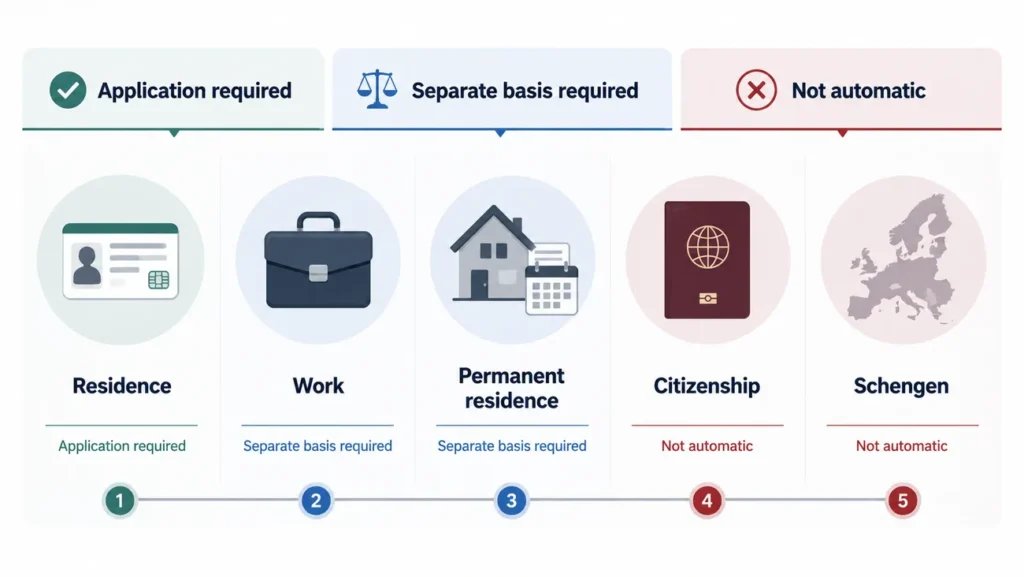
| Status or right | Included automatically? | Explanation |
|---|---|---|
| Temporary residence | No, application required | Ownership creates the ground; permit requires separate application and approval |
| Work authorisation | No | Requires separate work permit; check for applicable exemptions |
| Family residence | No | Family members apply separately under family reunification basis |
| Tax residence | No | Determined by tax law based on presence and connections, not immigration permit |
| Permanent residence | No | Separate application after required period of continuous lawful residence |
| Citizenship | No | Separate naturalisation process with additional conditions |
| Schengen residence | No | Montenegro is not a Schengen member |
Montenegro uses the euro but is not a member of the European Union or the Schengen Area as of August 2026. The country is an EU accession candidate, and negotiations are ongoing, but no confirmed accession timeline exists, and current property owners should not make plans on the assumption that their residence rights will automatically change if Montenegro joins the EU at some future date.
Comparing Common Residence Grounds
| Residence ground | Property required? | Local work included automatically? | Main consideration |
|---|---|---|---|
| Owned real estate | Yes | No | Annual renewal and strict absence rules |
| Employment | No | Work is tied to the authorised employment basis | Requires compliant employment and work authorisation |
| Family reunification | No | Not automatically in every case | Depends on the principal family member’s status |
| Digital nomad | No | Limited to the activities permitted under that status | Income and remote-work conditions apply |
| Study | No | Not automatically | Valid enrolment and education conditions required |
These grounds are not interchangeable. Each has separate eligibility, documentation, employment and renewal rules.
Family Members
Purchasing property in one family member’s name does not automatically give residence status to spouses, children or other relatives. Each family member requires their own valid immigration basis.
Spouses and minor children of a temporary residence holder may be eligible to apply for residence on the basis of family reunification, which is a distinct legal ground under the Law on Foreigners. This requires separate applications with supporting documents confirming the family relationship: marriage certificates, birth certificates and, where applicable, adoption or guardianship documentation. Foreign certificates generally require certified Montenegrin translation and may require an apostille or consular legalisation unless an applicable international agreement removes that requirement.
A family-reunification permit is issued for no more than one year and cannot extend beyond the expiry of the principal applicant’s temporary residence permit.
Practical points for family applications:
- Each family member’s passport must be valid and presented at application
- Proof of the family relationship must be authenticated and translated
- Health insurance must cover each family member individually
- Financial evidence should demonstrate sufficient means for the whole family unit
- If the property is registered only in one spouse’s name, the other spouse applies as a family member, not as a property owner
- Minor children approaching adulthood should review their status options before they turn 18, as the basis for their residence may need to change
Families planning to relocate together should treat residence applications for all members as a coordinated process, not as a series of independent steps that can be completed at different times without coordination.
Renewal and Absence Rules
Temporary residence based on property ownership is issued for one year and must be renewed annually. Renewal is not automatic — a new application must be submitted to the Ministry of Interior. Under Article 64 of the Law on Foreigners, the renewal application must be submitted no earlier than 60 days and no later than 30 days before the current permit expires. Where foreign certificates, apostilles or translations are required, document preparation should begin well before that window opens.
For a renewal to succeed, the qualifying conditions must continue to be met:
- The property must still be owned by the applicant and registered in the cadastre
- Confirm with the competent MUP office which evidence is required to show that the property continues to satisfy the current statutory conditions, including any applicable value requirement
- Evidence of fulfilled tax obligations: Article 64 of the Law on Foreigners requires, for renewal of a property-based permit, evidence that the applicant has fulfilled the applicable tax obligations during the permit period; confirm with the competent MUP office which certificates and payment records must be submitted
- Health insurance must be valid for the new period
- Financial evidence must be updated to reflect current circumstances
- Foreign certificates such as criminal record certificates may need to be refreshed if they have expired
On absence rules: Article 65 of the Law on Foreigners provides that a temporary residence permit based on property ownership may cease to be valid if the holder remains outside Montenegro for more than 30 days during the permit period. The humanitarian exception provided in Article 65 is expressly linked to family-reunification permits and should not be assumed to apply to property-based residence. Applicants planning any absence longer than 30 days should obtain individual legal advice before leaving Montenegro.
This Article 65 rule governs the validity of the annual permit itself and is separate from the continuity test that applies when calculating the five-year period for permanent residence. Under Article 86, the five-year period may still be treated as continuous where the applicant’s total absences during that period did not exceed ten months, or where a single continuous absence did not exceed six months. The more permissive Article 86 thresholds do not authorise absences that would trigger the Article 65 cessation rule in any individual permit year.
Renewal checklist:
- Confirm the property remains in your name in the current cadastral record
- Obtain a fresh list nepokretnosti showing current ownership
- Confirm with the competent MUP office which evidence of property value is required at renewal
- Obtain evidence that the applicable tax obligations for the permit period have been fulfilled (required by Article 64)
- Renew health insurance before expiry
- Refresh criminal record certificate if required
- Update proof of financial means
- Confirm your address registration is current
- Submit the renewal application no earlier than 60 days and no later than 30 days before expiry
- Keep records of time spent in Montenegro — absences of more than 30 days may cause the permit to cease under Article 65; no humanitarian exception applies to property-based permits
- Submit the renewal application in person at the competent MUP office (Article 64 requires personal submission for renewals)
Selling the property, transferring ownership below the qualifying share, or any change that removes the factual basis of the original application will affect the ability to renew. An applicant who disposes of the qualifying property during a permit year cannot assume the permit will renew on the same ground.
Permanent Residence and Citizenship
The relationship between property-based temporary residence and permanent residence is one of the most frequently misunderstood aspects of this topic — and one where official guidance and the statutory text have not always been consistent.
Under Article 86 of the current consolidated Law on Foreigners, permanent residence may generally be available after five years of continuous lawful residence based on temporary residence. The current consolidated statutory text does not expressly exclude temporary residence based on owned real estate from this calculation. This represents a change from what some older official English-language guidance stated, and it means that relying on the government’s online summary pages — rather than the current law itself — carries a risk of acting on superseded information.
That said, five years of property-based permits does not automatically produce permanent residence eligibility. The applicant must maintain valid temporary residence throughout the relevant period and satisfy the separate continuity test in Article 86. Under that article, multiple absences during the five-year period may total no more than ten months in aggregate, and a single continuous absence may not exceed six months. In addition, each annual property-based permit remains subject to the Article 65 rule that an absence of more than 30 days during a permit year may cause that permit to cease — a rule that operates separately from the Article 86 continuity thresholds and cannot be overridden by them. The applicant must also meet the additional conditions under Article 88 in force at the time of the permanent-residence application: sufficient means, health insurance, secured accommodation, basic knowledge of the Montenegrin language, and evidence that tax obligations have been fulfilled. Approval is not guaranteed by meeting only the time requirement.
Because official English-language summaries may not yet reflect the most recent amendments, applicants with long-term settlement objectives should obtain written confirmation from the Ministry of Interior or a qualified immigration lawyer regarding how their individual residence history will be assessed before planning on a five-year route to permanent residence.
Citizenship is an entirely separate process with its own statutory conditions, including language proficiency and integration requirements. The Government of Montenegro citizenship and residency overview provides a general overview of the citizenship process.
The citizenship-by-investment programme that was available to qualifying investors ended on 31 December 2022. It is no longer open. Purchasing real estate in Montenegro in 2026 does not provide a direct route to citizenship, and any representation to the contrary should be treated with significant scepticism.
Common Mistakes
The following are common practical errors that can undermine an application or property purchase. Each is avoidable with adequate preparation.
1. Relying on an outdated article claiming there is no minimum value Pre-2026 information on this topic is no longer accurate. The €150,000 taxable base requirement has been in force since January 2026. Verify all information against current official sources.
2. Confusing the contract price with the taxable base in the transfer tax decision The €150,000 threshold is determined by the taxable base stated in the real estate transfer tax decision — not the purchase price in the contract. These figures may differ significantly. Obtain transaction-specific advice before committing, and do not treat any informal estimate as confirmation that the threshold will be met.
3. Paying a deposit before checking the cadastral record A clean-looking listing does not guarantee clean title. The property sheet may reveal mortgages, inheritance disputes, unresolved co-ownership issues or discrepancies in the registered use. Check the cadastre before any non-refundable payment.
4. Treating an off-plan reservation as proof of ownership A reservation agreement, a sales contract for a future unit, or a payment receipt does not constitute registered ownership. Residence applications require actual cadastral registration.
5. Buying an ownership share below the statutory minimum The Law on Foreigners requires sole ownership or a co-ownership share of at least one half of a qualifying property. A smaller fractional interest does not satisfy the ownership requirement. Verify the share that will be transferred before signing.
6. Expecting automatic residence for the whole family Spouses and children are not included in the property owner’s permit. Each family member requires a separate application under the appropriate legal basis.
7. Assuming the permit includes employment rights The permit does not automatically authorise employment. Working without a valid separate authorisation has legal consequences.
8. Applying after the lawful period of stay has expired Applications submitted after expiry of lawful stay create significant legal complications. Begin preparing documents well before expiry.
9. Ordering foreign documents too early or too late Criminal record certificates and similar documents have validity periods. Ordered too early, they expire before the application is submitted; ordered too late, they cannot be authenticated and translated in time.
10. Ignoring translation requirements and name inconsistencies All foreign documents must be translated by a licensed court interpreter. Any inconsistency in the spelling or transliteration of the applicant’s name across documents will trigger requests for clarification.
11. Overlooking annual property taxes Outstanding property tax obligations can complicate the renewal process. Check for unpaid taxes before purchasing and maintain payments throughout ownership.
12. Assuming five annual permits automatically guarantee permanent residence Under the current consolidated Law on Foreigners, five years of continuous temporary residence may support a permanent-residence application — but approval is not automatic. The continuity test under Article 86 requires that total absences during the five-year period do not exceed ten months in aggregate, and that no single continuous absence exceeds six months. Additionally, each annual permit is independently subject to the Article 65 rule that an absence exceeding 30 days may cause that permit to cease. The applicant must also meet the Article 88 conditions: sufficient means, health insurance, secured accommodation, basic Montenegrin language knowledge and fulfilled tax obligations. Confirm how the Ministry will assess your individual residence period before making a long-term settlement plan.
13. Believing Montenegrin residence equals Schengen residence Montenegro is not in the Schengen Area. A Montenegrin residence permit has no effect on a third-country national’s ability to enter or reside in Schengen member states.

Is Property-Based Residence Right for You?
Property-based temporary residence is one of several legal grounds for residing in Montenegro, and it is the most practical option for some applicants and unsuitable for others.
It tends to work well for:
- Second-home owners who spend significant time in Montenegro and want a legal basis for extended stays
- Retirees or financially independent buyers who do not need local employment and can demonstrate sufficient means
- Families intending to live in their own home rather than renting, where the property purchase and the residence plan align naturally
- Investors in their own accommodation who are comfortable with annual renewals and the associated requirements
It may be insufficient or impractical for:
- People whose primary goal is local employment: a work permit or employment-based residence may be more appropriate, as property-based residence does not include work rights
- Buyers who cannot document the required €150,000 taxable base: where the value-document requirement applies, the property cannot serve as the qualifying ground if the taxable base stated in the accepted official document is below €150,000.
- Applicants seeking a direct route to citizenship: no such route exists through property-based temporary residence in the current legal framework
- Highly mobile people who cannot comply with absence requirements: under Article 65, an absence of more than 30 days during a permit year may cause the permit to cease, and no humanitarian exception applies to property-based permits; applicants who regularly spend long periods outside Montenegro should assess whether they can realistically comply before committing to this ground
- Digital nomads or remote workers who may find purpose-built digital nomad or business-related residence grounds more suited to their pattern of activity, depending on applicable rules
| Applicant goal | Property-based residence may fit? | Main consideration |
|---|---|---|
| Live in an owned home | Yes, if threshold met | Annual renewal required; property must remain qualifying |
| Work for a local employer | Not on its own | Separate work authorisation needed |
| Obtain quick citizenship | No | No direct citizenship route through property ownership |
| Relocate with family | Yes, with coordination | Each family member applies separately; plan in advance |
| Spend only short periods in Montenegro | Unlikely to be worth it | Absence rules; annual renewal cost and administration |
Alternative grounds for temporary residence — employment, company establishment, family reunification, study and others — each carry their own conditions and suitability profiles. Applicants who are uncertain which ground fits their situation should take advice from an independent immigration lawyer before choosing a strategy.
Before You Buy
Property creates the foundation for a residence application — it does not deliver residence itself. For most buyers from outside the EU, EEA and Switzerland, the relevant measure is the taxable base in the real estate transfer tax decision, not the headline price, and that base must reach €150,000. Checking this figure, the cadastral record and the property’s legal status before paying any non-refundable sum is not a precaution — it is a prerequisite.
The permit, once issued, lasts one year and requires annual renewal, submitted in person within the statutory window of 60 to 30 days before expiry. Under Article 65, an absence of more than 30 days during a permit year may cause the permit to cease — and no humanitarian exception applies to property-based permits. Rights to work, to bring family members or to access Schengen travel are not part of what the permit provides; each requires its own separate process and legal basis.
Property-based residence is not an automatic settlement route. Under the current consolidated Law on Foreigners, five years of continuous lawful temporary residence may support a permanent-residence application, subject to the Article 86 continuity thresholds — total absences not exceeding ten months and no single absence exceeding six months — and the additional statutory conditions under Article 88. Do not assume that five permit cards alone guarantee approval. Because official online guidance may not yet fully reflect the most recent amendments, verify the current position with a qualified immigration lawyer before building a long-term plan around any particular timeline.
Before committing to a purchase in which residence is part of the objective, align your property choice, legal due diligence and immigration plan. A qualified real estate adviser and an independent immigration or legal consultant, working together, are better placed to review your specific circumstances than any general article can be.
Requirements under the Law on Foreigners may be amended, and administrative practice at individual Ministry of Interior offices can vary. Verify current requirements before signing any agreement and before submitting any application.
The information in this article reflects the legal framework as of August 2026 and is intended for general guidance only. Residence requirements and document lists depend on individual circumstances, nationality and the practice of the competent authority. This article does not constitute legal or immigration advice. Readers should consult a qualified lawyer or immigration professional for advice specific to their situation.
 Real estate in Georgia
 Real estate in Cyprus
 Real estate in the UAE
 Real estate in Bali
 Real estate in Thailand
 Real estate in Spain
 Real estate in Saudi Arabia
 Real estate in Turkey
 Real estate in Zanzibar
 +382 60 099359
 hello@residence-estate.me
 The Old Bakery Residences, Budva 85310, Montenegro



 Get catalogue of TOP-7 objects