
 +382 60 099359


Montenegro’s amended Law on Foreigners, in force since 17 January 2026, sets the minimum for residence through property at EUR 150,000, not EUR 200,000. The figure is the tax base in the municipal real-estate transfer tax decision, which new non-EU applicants must submit. The EUR 200,000 figure was only a government proposal in November 2025. Status checked on 23 October 2026.
Reports on residence by property in Montenegro have quoted two different thresholds: EUR 150,000 and EUR 200,000. The Official Gazette of Montenegro settles the question. The law is in force and the adopted number is EUR 150,000. This article sets out what the text says, who it applies to and what remains open.
Which figure is correct: EUR 150,000 or EUR 200,000?
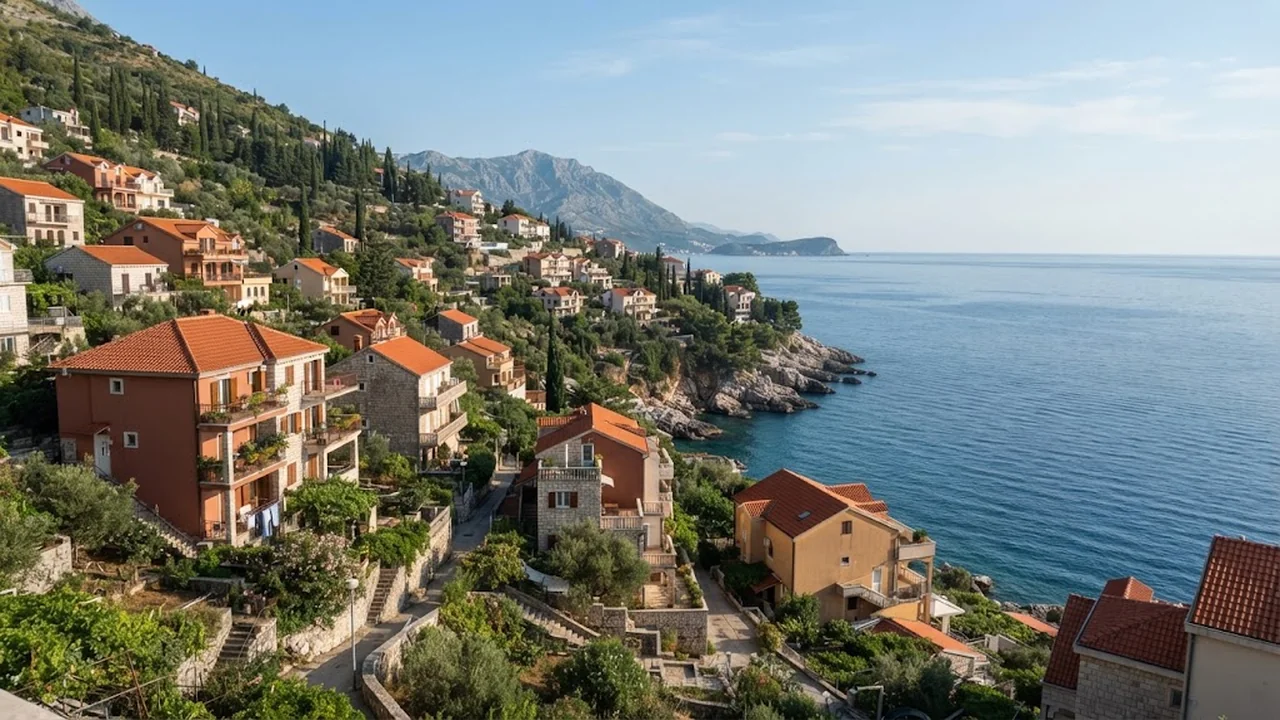
The adopted figure is EUR 150,000. In November 2025 the Government approved draft amendments, and media reported a threshold of EUR 200,000. That was a proposal. The Law on Amendments and Supplements to the Law on Foreigners was adopted by Parliament on 31 December 2025 and published in Sluzbeni list CG 3/2026. Article 24 of the amending law, which changes Article 56 of the Law on Foreigners, contains the number 150,000.
The wording matters. The law does not say “the purchase price must be at least EUR 150,000”. It requires proof of the value of the property issued by the local-government body competent for tax collection: the decision on determining the real-estate transfer tax, whose tax base is not less than EUR 150,000.
Note: the text of the PDF on the Gazette site was extracted by machine and is partly garbled, so the wording above is a paraphrase. Check Article 24 on the Gazette page before quoting it.
What changed: before and after
| Point | Before 17 January 2026 | From 17 January 2026 |
|---|---|---|
| Basis | Temporary residence for use and disposal of real estate owned in Montenegro (Article 38 of the 2018 law) | Same basis, with an added document |
| Minimum value | None in the statute | Tax base of at least EUR 150,000 |
| Proof of value | Proof of ownership | Ownership plus the municipal transfer-tax decision |
| Extension | Under the old rules | New-regime permits: proof that taxes were paid during the permit (Article 31, amending Article 64) |
Who is affected and who is not
- Affected: non-EU foreign nationals applying for a new temporary residence permit based on property ownership, in proceedings begun after 17 January 2026.
- Exempt from the value proof: citizens of EU member states and their family members, and citizens of Iceland, Liechtenstein, Norway and Switzerland.
- Applications begun before 17 January 2026: completed under the old law (Article 217a).
- Existing permit holders: under Article 217b, extension requests filed after entry into force are completed under the old Law on Foreigners. The EUR 150,000 test is therefore not applied to them according to the transitional text.
The November 2025 proposal included a one-year alignment period for existing holders. The adopted text instead keeps the old procedure for extensions of earlier permits.
Extension and tax proof
For permits issued under the new regime, the extension application must include proof that tax obligations were paid during the validity of the permit (Article 31). The text also sets an earliest filing date before expiry, expressed as 60 days, but the extracted wording is unclear, so verify it. It is not confirmed whether tax-paid proof is also requested from holders whose extension runs under the old law through Article 217b.
What is still open
- Bylaws: due within 12 months of entry into force (Article 216v), around January 2027. Until then, the old bylaws apply where they do not conflict with the law. Which property types and what area qualify is expected to be set there.
- How the tax base is calculated: not verified whether the municipal authority uses the contract price or an assessed value, and whether a price above EUR 150,000 always gives a base above that figure.
- Later changes: a later amendment cited as SL CG 33/26 and a further Law on Foreigners package adopted by Parliament on 15 October 2026 were not read. Reports on that package did not describe property-based residence.
- Visa D: for property purposes it requires proof of ownership and of funds for subsistence, accommodation, health insurance and return costs. No value threshold is stated in that article.
What to do in each situation
Buyer who needs a residence basis
- Request the transfer-tax decision from the municipality and read the tax base before relying on residence.
- Treat a base below EUR 150,000 as insufficient for a new application.
- Remember that property is a conditional route, not a permanent right.
Existing permit holder or landlord
- Keep property taxes paid and keep the receipts.
- Ask the Ministry of Interior which procedure applies to your extension.
EU, Norwegian, Swiss, Icelandic or Liechtenstein citizen
The value proof does not apply to you under the amending law.
Frequently asked questions
Is the threshold EUR 150,000 or EUR 200,000?
EUR 150,000, as the tax base in the transfer-tax decision. EUR 200,000 was a proposal that is not in the adopted text.
Since when does it apply?
Since 17 January 2026, the eighth day after publication in the Official Gazette on 9 January 2026.
Does it apply to EU citizens?
No. EU citizens and their family members are exempt from the value proof, as are citizens of Iceland, Liechtenstein, Norway and Switzerland.
Do current permit holders have to meet it?
According to Article 217b, extensions of earlier permits are completed under the old law.
Are more rules coming?
Yes. Bylaws are expected by about January 2027.
Official sources
- Official Gazette of Montenegro: act page, SL CG 3/2026
- Full text of the Law on Amendments (PDF)
- Ministry of Interior of Montenegro
- Ministry of Finance: real-estate transfer tax
Checked on 23 October 2026, based on the text of SL CG 3/2026. This article is general information, not legal, tax or immigration advice. Rules can change; confirm the current requirements with the Ministry of Interior and a licensed lawyer.
 Real estate in Georgia
 Real estate in Cyprus
 Real estate in the UAE
 Real estate in Bali
 Real estate in Thailand
 Real estate in Spain
 Real estate in Saudi Arabia
 Real estate in Turkey
 Real estate in Zanzibar
 +382 60 099359
 hello@residence-estate.me
 The Old Bakery Residences, Budva 85310, Montenegro



 Get catalogue of TOP-7 objects