
 +382 60 099359


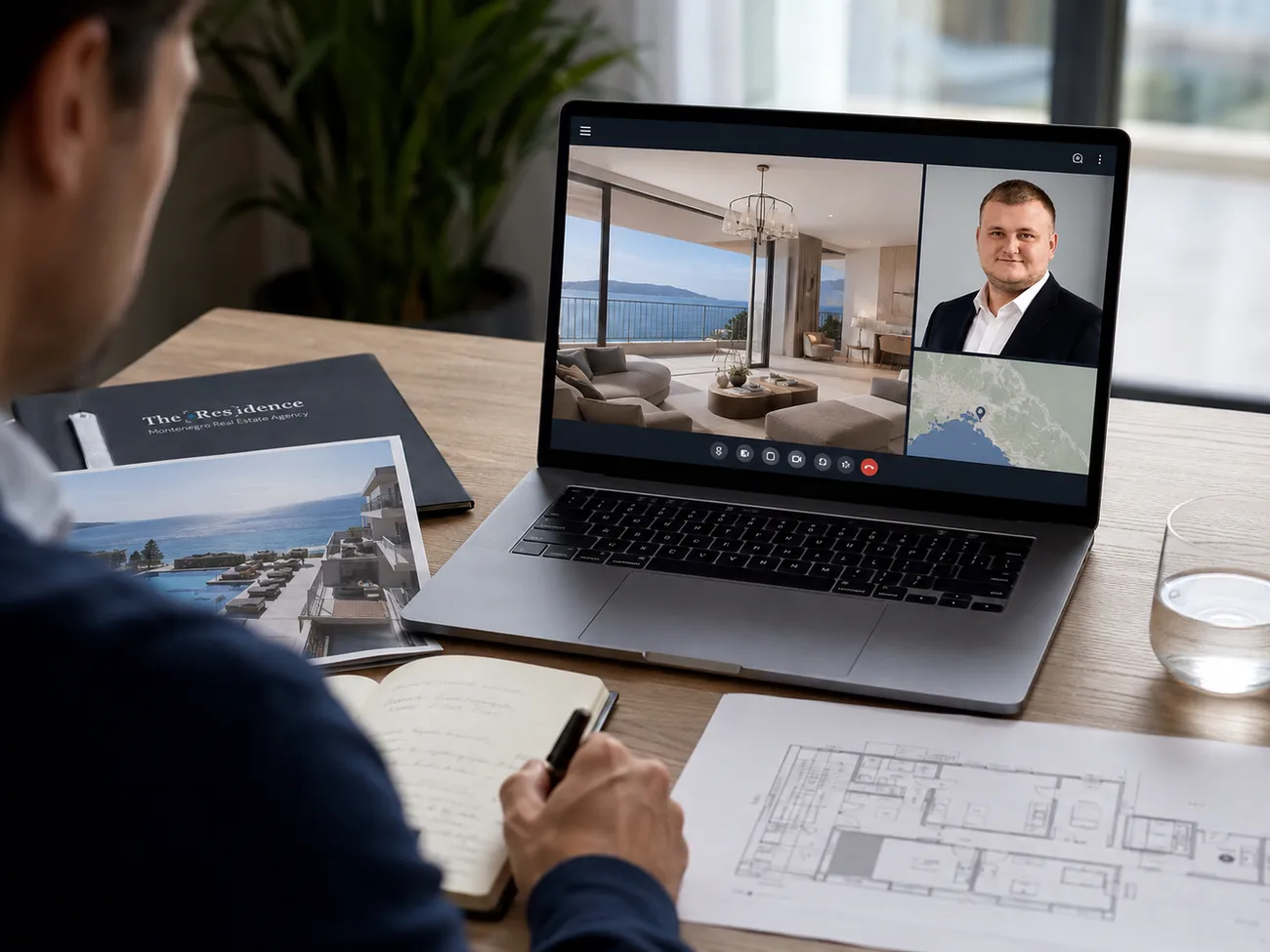

Foreign nationals can generally purchase property in Montenegro without travelling for the transaction itself, provided the deal is properly structured and an authorised representative acts under a valid Power of Attorney where required. An authorised representative may handle formal steps — including signing, appearing before the notary and dealing with registration filings — to the extent that those powers are expressly granted in the Power of Attorney. What remote buying does not remove is the need for independent legal review, physical or documented verification of the property, compliant international payment and confirmation that ownership has been correctly registered.
This guide covers the full process for buyers who cannot, or prefer not to, be present in Montenegro at every stage: from shortlisting a property to receiving the final cadastral confirmation.
Remote Property Purchase in Montenegro: Quick Facts
| Question | Short answer |
|---|---|
| Can a foreigner buy remotely? | Generally, yes |
| Do I have to travel to Montenegro? | Not necessarily for the formal transaction stages if an authorised representative acts under a valid Power of Attorney |
| Who can sign for me? | An authorised representative acting within the powers expressly granted in the PoA |
| Can foreigners buy apartments and houses? | Generally, yes; restrictions apply to certain categories of land and protected property |
| Is a Montenegrin bank account always required? | Not necessarily; the payment structure should be confirmed for the specific transaction |
| Main tax on qualifying resale purchases | Progressive real estate transfer tax: 3% / 5% / 6% |
| What replaces transfer tax in some transactions? | VAT may apply where the supply falls within the VAT regime |
| Most important legal document to check | Current cadastral extract (list nepokretnosti) |
| Who should conduct legal due diligence? | An independent Montenegrin lawyer acting for the buyer |
| When does ownership transfer? | Through registration of the ownership right in the Cadastre |
| Does buying property automatically give residence rights? | No. Property ownership and residence procedures are separate |
The exact procedure, taxes, authentication requirements and timeline depend on the property and transaction. They should be confirmed for the specific purchase before funds are committed.
What Foreign Buyers Can and Cannot Purchase Remotely
Foreign buyers should also be aware that ownership rules are not identical across all property types. Foreign nationals can generally acquire apartments, houses and other residential property in Montenegro. However, statutory restrictions apply to certain categories of real estate under Montenegro’s Law on Property Relations (Zakon o svojinsko-pravnim odnosima). Foreign persons cannot generally own agricultural land, forests and forest land, islands, certain property within one kilometre of the land border, and several other protected categories. A limited exception allows a foreign individual to acquire up to 5,000 m² of agricultural or forest land where a residential building located on that land is part of the same transaction. The classification of the specific property should therefore be confirmed with an independent lawyer before any commitment is made. Our article on “Foreign ownership of land in Montenegro” covers this in more detail.
Who Handles a Remote Purchase?
| Participant | Main role |
|---|---|
| Buyer | Approves the property, contract, payment and key decisions |
| Real estate agent | Property search, viewings, documentation coordination and transaction logistics |
| Independent lawyer | Buyer-side legal advice, due diligence, contract review and PoA advice |
| Authorised representative | Performs only the actions granted under the PoA |
| Notary | Performs the independent public/notarial function required for the transaction |
| Bank | Processes payment subject to its compliance requirements |
| Cadastre | Records the ownership right and other registered property rights |
| Surveyor / inspector | Assesses physical condition where commissioned |
Buying from abroad?
Tell us your budget and preferred location. We can prepare a shortlist of properties available for live video viewing and send the relevant property documentation before you decide what to inspect in detail.
How Remote Buying Works

A structured remote purchase typically follows this sequence. Each stage has a defined outcome that should be confirmed before moving to the next.
- Define the buying brief. Before viewing anything, a buyer should be clear on budget, preferred location, property type, intended use and any specific requirements. Vague briefs produce irrelevant shortlists and wasted time. See our guide to the “best places to buy property in Montenegro” if you are still comparing locations.
- Shortlist properties. Based on a clear brief, an agent compiles a relevant shortlist with documentation. At this stage, a buyer should be receiving cadastral parcel references, building information and factual descriptions — not just marketing materials.
- Arrange live video viewings. A recorded or live-streamed walkthrough conducted by a representative on-site is not a substitute for physical inspection, but it is significantly more informative than listing photos. A good viewing covers every room, the building entrance and communal areas, parking, the view from each window and any visible defects.
- Appoint independent legal representation. This step should happen before due diligence, not after. A lawyer acting for the buyer — not the seller, not the agent — conducts the legal check, reviews contract drafts and advises on the Power of Attorney wording.
- Conduct due diligence. The independent lawyer obtains and reviews the current cadastral extract (list nepokretnosti), verifies registered ownership, checks for registered mortgages, liens, annotations and encumbrances, and confirms the legal status of the building. This stage is covered in detail in the Due Diligence section below.
- Prepare and authenticate the Power of Attorney. Once a specific property is identified and the buyer is ready to proceed, the PoA is drafted, signed before a notary in the buyer’s country and authenticated as required for recognition in Montenegro.
- Review and approve the purchase contract. The buyer should receive the full draft contract in a language they understand, with time to raise questions before the representative signs. No buyer should approve a contract based solely on a verbal summary.
- Complete notarisation and payment. The representative appears before the Montenegrin notary and the contract is executed. Payment is arranged in line with the contractual terms, through a verifiable banking channel, against a defined milestone.
- Register ownership. Following notarisation, the transaction is submitted to the Cadastre for registration. This stage takes time and requires active follow-up.
- Obtain the final cadastral extract and arrange handover. Once registration is complete, the buyer should receive an updated cadastral extract confirming their name as the registered owner. Physical handover, key collection, meter readings and utility transfers are then arranged.
Table 1: Which Steps of Buying Property in Montenegro Can Be Done Remotely?
| Stage | Can it be done remotely? | Who handles it? | Buyer control point |
|---|---|---|---|
| Define buying brief | Yes | Buyer | Clear written brief agreed with agent |
| Shortlist and viewings | Partially — live video possible | Agent / representative | Live video completed; cadastral reference obtained |
| Legal appointment | Yes | Buyer appoints lawyer directly | Signed engagement confirmed in writing |
| Due diligence | Yes — lawyer works remotely | Independent lawyer | Written due diligence report received before contract |
| PoA preparation | Partially — signed locally, authenticated | Buyer + local notary | Wording approved by Montenegrin lawyer before execution |
| Contract review | Yes | Buyer + independent lawyer | Buyer approves final text before representative signs |
| Notarisation and signing | Representative attends in person | Representative + Montenegrin notary | Confirmation of executed contract received |
| Payment | Buyer instructs from abroad | Buyer’s bank | SWIFT confirmation retained; beneficiary independently verified |
| Cadastre registration | Representative or lawyer handles filing | Representative / lawyer + Cadastre | Registration outcome confirmed in writing |
| Final extract and handover | Partially | Lawyer / representative | Updated cadastral extract obtained; keys and handover documented |
How Long Does a Remote Property Purchase Take?
There is no single statutory timeline for the entire purchase. The total duration depends on the property, the readiness of the documentation, the seller, authentication of the Power of Attorney, banking checks and the time required for cadastral registration.
As a practical planning range, buyers should usually allow several weeks to a few months for the transaction from the point at which a property has been selected. Straightforward cash purchases with clean documentation may progress faster, while authentication of a foreign Power of Attorney, banking compliance, title issues or additional cadastral documentation can extend the process. This is a planning range rather than a statutory deadline.
| Stage | What affects the timing |
|---|---|
| Property selection | Number of properties reviewed and availability of documentation |
| Due diligence | Complexity of title, cadastral records, permits and existing encumbrances |
| Power of Attorney | Country of execution, apostille/legalisation and translation requirements |
| Contract preparation | Negotiations, document corrections and conditions agreed by the parties |
| Payment | Buyer-bank compliance, source-of-funds checks and international transfer processing |
| Registration | Completeness of the application and Cadastre processing |
Buyers working to a specific completion date should establish a transaction timetable with their lawyer before signing a reservation or preliminary agreement rather than relying on a generic online estimate.
Before Paying a Reservation Deposit
A reservation payment should not be treated as a harmless way to “hold” a property. Before transferring money, the buyer should understand in writing:
- who receives the deposit;
- what exactly is being reserved;
- whether the payment is refundable;
- the circumstances in which the seller may retain it;
- what happens if due diligence identifies a legal problem;
- what happens if the seller withdraws;
- whether the amount is credited towards the purchase price;
- the deadline for signing the next agreement.
Do not rely on a generic assumption about whether a deposit is refundable. The consequences depend on the wording and legal nature of the specific agreement.
Power of Attorney

A Power of Attorney (punomoć) is the legal instrument that authorises another person to act on the buyer’s behalf in Montenegro. It is not a formality — the scope of authority it grants determines what the representative can and cannot do, and nothing beyond what the document expressly covers.
What the PoA Should Cover
A PoA for a remote property purchase typically authorises the representative to carry out some or all of the following, depending on the transaction:
- Signing a preliminary or reservation agreement where applicable
- Signing the final sale and purchase agreement
- Attending and executing documents before a Montenegrin notary
- Submitting documents to and receiving documents from relevant authorities
- Filing for cadastral registration of ownership
- Obtaining certified copies of relevant official documents
- Handling administrative tax-related filings connected with the transaction where legally permitted
- Receiving keys and completing handover documentation where agreed
The principle that should guide the drafting is straightforward: a PoA should give the representative enough authority to complete the agreed transaction — and no broader authority than that. An overly wide document — one that authorises the representative to sell the property, borrow against it, amend the agreed price or deal with unrelated matters — creates unnecessary risk. A buyer should discuss the following with their independent lawyer before the PoA is finalised:
- The precise property, including cadastral identifiers where available
- An explicit list of permitted actions
- Clear limits on any payment-related authority, or exclusion of it entirely
- The PoA’s duration and whether it is valid beyond the specific transaction
- Whether sub-delegation (subdelegacija) is permitted and, if so, to whom
- Whether the representative may sign amendments to the agreed contract
- Whether, and under what conditions, the representative may receive funds on the buyer’s behalf
Apostille and Legalisation
A PoA signed before a notary outside Montenegro generally needs to be recognised as a valid foreign public document before it can be used there. The authentication procedure depends on the country where the document was executed and any applicable international arrangements.
Montenegro is a party to the Hague Convention Abolishing the Requirement of Legalisation for Foreign Public Documents — see Montenegro’s accession documentation. Where the Hague Apostille Convention applies between Montenegro and the country in which the document is issued, an apostille will generally replace the traditional legalisation requirement. Bilateral agreements between Montenegro and certain countries may simplify or remove authentication requirements further. For documents from jurisdictions outside any applicable convention or treaty, a different and more involved form of legalisation may be required.
Before signing a PoA before a foreign notary, the buyer’s Montenegrin lawyer should confirm the precise wording, format and authentication requirements. If the document is drafted incorrectly or its format does not meet Montenegro’s procedural requirements, it may need to be re-executed. Translation requirements should also be confirmed in advance, not assumed.
The Power of Attorney should be broad enough to complete the transaction as agreed — and no broader. What the document permits defines what the representative can do.
Documents a Remote Buyer May Need
The exact document package depends on the transaction, the buyer’s country and the requirements of the professionals and banks involved. A remote buyer should be prepared to discuss the following with their lawyer:
| Document | Why it may be needed |
|---|---|
| Valid passport / identification | Identity verification |
| Power of Attorney | Allows the authorised representative to perform specified actions |
| Apostille or other authentication | May be required for recognition of a foreign PoA |
| Certified translation | Where foreign documents need to be used in Montenegro |
| Purchase or preliminary agreement | Establishes the contractual terms of the transaction |
| Source-of-funds documentation | May be requested by banks or other obliged entities for compliance checks |
| Bank payment evidence | Creates a traceable record of the purchase payment |
| Current cadastral extract | Confirms the registered position of the property |
| Handover documentation | Records keys, inventory, meter readings and physical delivery |
This is not a universal statutory document list. The buyer’s Montenegrin lawyer and bank should confirm the documents required for the specific transaction before signing or transferring funds.
Due Diligence From Abroad

A video viewing is not due diligence. It is a useful tool for assessing layout, condition and context — but it does not tell a buyer whether the seller has legal title, whether the property carries a mortgage, or whether its registered description matches the physical space. These questions require a separate, independent legal process.
The legal review is intended to confirm the seller’s registered title, identify registered encumbrances and determine whether any known legal issues could affect the proposed transfer. A thorough remote due diligence process covers three distinct areas.
1. Legal Check
The independent lawyer should review:
- The current cadastral extract (list nepokretnosti), which identifies the registered owner, the property’s cadastral description, and any registered rights, mortgages, liens, annotations or other entries affecting the property
- Whether the seller’s ownership share matches what is being sold
- Any court-related entries or restrictions recorded against the property
- The legal status of the building — whether it has been constructed with relevant permits or whether its legal position has been regularised
- Whether any outstanding issues could prevent or complicate the transfer of ownership
- The accuracy of cadastral parcel and unit identifiers relative to the property being purchased
Montenegro’s Law on State Survey and Real Estate Cadastre (Zakon o državnom premjeru i katastru nepokretnosti) establishes the Cadastre as the official public registry of real estate and rights over it — see the official source. A buyer purchasing remotely should treat the current cadastral extract as the primary reference for registered ownership, not the seller’s verbal or written representation.
Note that the cadastral extract reflects the registered position. It shows registered rights and encumbrances but does not guarantee the identification of every potential unregistered dispute or claim. Independent legal review exists precisely to assess what the cadastral record shows and what, if anything, requires further investigation.
2. Physical Check
A lawyer’s review of paperwork does not assess the physical condition of the property. For a completed apartment or villa, a physical inspection — whether conducted by a trusted local contact, a professional surveyor or a detailed live video walkthrough — should cover:
- Visible condition of walls, ceilings and floors
- Moisture or water ingress
- Windows, doors and glazing
- Electrical systems
- Plumbing and water pressure
- Heating, ventilation and air conditioning
- Communal areas, stairwells and lifts where applicable
- Parking, storage and access routes
- Actual condition compared with listing photographs
For houses, land or properties requiring renovation, the threshold for a formal physical inspection is higher. A professional survey may be appropriate before any substantial payment commitment is made.
3. Commercial Check
The commercial check confirms what the buyer is actually purchasing. Items to verify include:
- What furniture, fixtures and fittings, if any, are included
- Parking space and storage allocation
- Agreed handover condition
- Payment schedule and milestone definitions
- For new-build transactions: the developer’s obligations, completion timeline and any contractual or statutory buyer protections that apply to the particular project
- For off-plan purchases: the current construction stage and what happens if the developer’s timeline changes
Table 2: Due Diligence Checks
| Check | What should be verified | Why it matters remotely | Evidence buyer should receive |
|---|---|---|---|
| Registered ownership | Owner’s name, ownership share, cadastral identifiers | Buyer cannot inspect physical documents independently | Current cadastral extract (list nepokretnosti) |
| Registered encumbrances | Mortgages, liens, annotations, registered third-party rights | Certain registered encumbrances may continue to affect the property unless properly discharged as part of the transaction | Confirmed clean extract or written explanation of any entries |
| Legal building status | Permits, regularisation, planning position | Legal issues may affect registration | Lawyer’s written assessment |
| Cadastral description | Match between registered description and physical property | Discrepancies create future complications | Comparison note from lawyer |
| Physical condition | Structural integrity, systems, access | Cannot be directly assessed by the buyer | Video inspection record; survey report where commissioned |
| Commercial terms | What is included, handover condition, payment schedule | Verbal assurances are difficult to enforce | Written schedule included in the contract |
A remote buyer should receive the cadastral extract and a written legal review before authorising any substantial payment — not after the contract has become commercially difficult to reverse.
Found a property but cannot visit Montenegro?
Send us the listing or property details. We can arrange a live viewing, collect the available property documentation and coordinate the next steps with your independent legal adviser.
Remote Purchase: Resale vs New Build
| Issue | Resale property | New build / off-plan |
|---|---|---|
| What can be physically inspected? | Usually the completed property | Depends on construction stage |
| Key legal focus | Existing title, encumbrances, registered description and building status | Developer, project documentation, contractual obligations and completion structure |
| Payment | Defined by the individual contract | May involve staged payments |
| Main completion risk | Existing legal/physical defects | Construction and completion risk |
| Tax treatment | May fall within transfer-tax regime | May fall within VAT regime depending on the transaction |
| Remote verification | Cadastre + physical inspection + legal review | Legal/project review + construction evidence + contractual milestone verification |
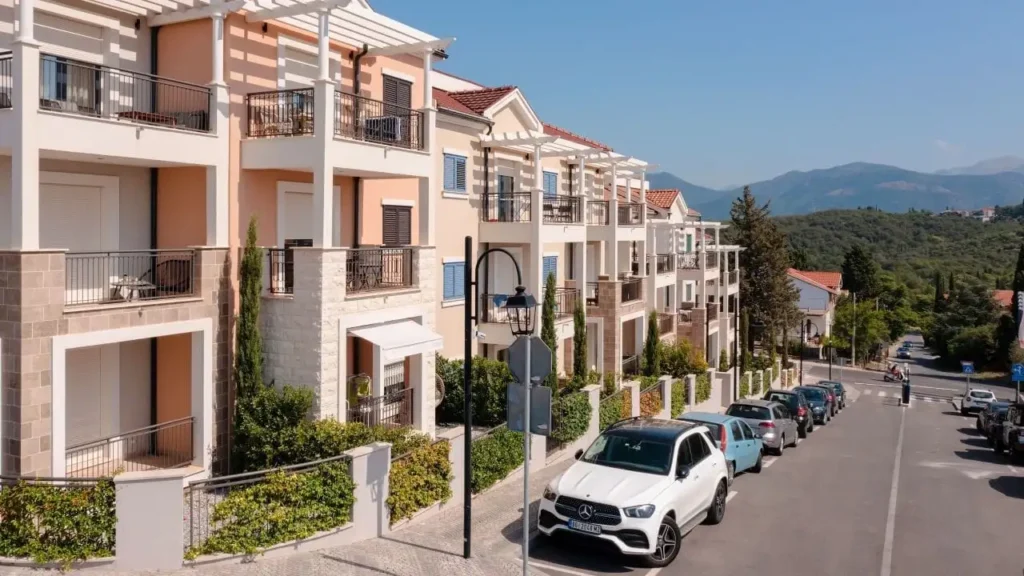
New buildings in Tivat for remote purchase


 Tivat
Tivat от 45.37м²


Contract, Notary and Signing

The purchase agreement (ugovor o kupoprodaji) is the legal instrument that defines the terms of the transaction. Before the representative signs it, the buyer should have reviewed the full draft — not a summary — in a language they genuinely understand. Any questions about price, payment schedule, handover conditions, penalties or title warranties should be resolved before execution, not after.
The Montenegrin notary (notar) performs an independent public function in formally executing the transaction and does not act as the personal legal representative of either party. The notary verifies the identities of the parties and checks that the document meets formal legal requirements. Where a participant does not understand the language of the document, a certified court interpreter (sudski tumač) may be required — the specific requirement depends on the participant’s language comprehension and the applicable procedural rules.
The buyer’s independent lawyer, by contrast, advises specifically on the buyer’s interests. This distinction matters particularly in a remote transaction. A buyer who has not appointed independent legal representation may assume that the notary’s involvement provides a layer of buyer-side protection that it does not actually provide.
Montenegro’s Law on Property Relations (Zakon o svojinsko-pravnim odnosima) provides the legal framework governing property rights and real estate transactions, including the rules on acquisition of ownership — see the official text. Buyers should satisfy themselves, through their own legal adviser, that the transaction is structured consistently with that framework.
After signing, the buyer should receive a copy of the executed agreement. This document confirms the transaction has taken place but does not confirm that ownership has been registered — registration is a separate subsequent stage.
Paying From Abroad

International property payments can involve additional compliance and documentation checks that a straightforward domestic transfer does not. The mechanics depend on the specific transaction — the contract structure, the currency, the banks involved and the applicable requirements on both sides.
Purchase prices are commonly settled through traceable banking channels in line with the contracted payment schedule. A buyer’s bank may request supporting documentation before processing a large international transfer: the signed purchase contract, identification documents, proof of source of funds and, in some cases, additional AML-related information. Such checks are common in large cross-border transactions, although the documentation requested varies by bank, jurisdiction and the customer’s profile. These requirements are not unique to Montenegro, but they can affect timing — and a contractual payment deadline can arrive faster than expected if preparation has been left too late.
Bank-detail fraud is a real risk in any international property transaction. Buyers should establish beneficiary account details through a secure and verifiable channel — ideally confirmed directly with the lawyer or notary handling the transaction — and should not act on account details received by email or messaging app without independent verification, particularly if details have changed unexpectedly.
Before Sending the Purchase Price
- Confirm the final signed contract is in place and you have a copy
- Independently verify the beneficiary’s account details through a direct and trusted channel — treat any unexplained last-minute change as a red flag
- Check the payment deadline in the contract and allow sufficient time for banking compliance
- Confirm the currency specified in the contract and clarify who bears transfer costs
- Ask your sending bank what documentation they require before initiating the transfer
- Retain the SWIFT confirmation or equivalent payment record
- Agree in advance what happens if the transfer is delayed — particularly in relation to contractual deadlines
Do not assume that a specific bank will guarantee processing within a particular timeframe. International transfers can be subject to correspondent banking delays, compliance holds or additional documentation requests that are outside anyone’s direct control.
The most secure remote payment is not the simplest — it is the one where each transfer corresponds to a verified contractual milestone and a document confirming that milestone has been met.
Registration and Handover
Signing the contract before the notary is not the final checkpoint. Under Montenegro’s Law on Property Relations, ownership of real estate acquired through a transaction is obtained by registration in the Cadastre. Until that registration is confirmed, the legal transfer of title is not complete. A buyer who treats contract signing as the conclusion of the process may not notice if the registration step encounters a delay or problem.
After the notarised agreement is executed, the transaction is submitted to the Cadastre for registration of the buyer’s ownership. The Cadastre processes the application and, subject to the documentation being in order, records the buyer as the new registered owner. The timeline for this process can vary depending on the specific circumstances and filing.
The buyer should ensure — through their representative or lawyer — that:
- The application for registration has been submitted promptly following notarisation
- Any Cadastre queries or requests for additional documentation are addressed without delay
- An updated cadastral extract is obtained once registration is confirmed
- The extract shows the buyer’s name correctly as the registered owner
An up-to-date cadastral extract is the primary practical document showing who is currently registered as the owner and what registered rights or encumbrances affect the property. The buyer should receive this directly, not simply be told that registration has been completed.
Physical handover — keys, remote controls, parking tokens, meter readings, inventory review — should be documented, even briefly. If the buyer is not travelling to Montenegro immediately, a representative can complete handover on their behalf, but the buyer should receive written confirmation of what was handed over and when. For buyers remaining abroad, property management arrangements should be agreed before handover, not as an afterthought.
Costs and Taxes
A remote purchase involves broadly the same costs as an in-person purchase, plus some additional items specific to the remote format. The categories below should be confirmed with an independent legal adviser or accountant for the specific transaction, as the applicable treatment depends on the property, the seller and the structure of the deal.
- Property purchase price — the primary contract amount
- Property transfer tax
For acquisitions subject to Montenegro’s real estate transfer tax, the tax is calculated progressively based on the taxable value:
– Up to €150,000 — 3% of the taxable value.
– From €150,000.01 to €500,000 — €4,500 + 5% of the amount above €150,000.
– Above €500,000 — €22,000 + 6% of the amount above €500,000.
Example: for a property with a taxable value of €300,000, the transfer tax is €12,000:
€4,500 + (5% × €150,000) = €12,000
These progressive rates have applied since 1 January 2024 and remain reflected in the current legislation.
2026 update: Montenegro amended the tax framework in 2026. Building land transactions that are subject to VAT were removed from the scope of real estate transfer tax. The applicable tax treatment and taxable base should therefore be confirmed for the specific transaction at the time of purchase. - VAT — a transaction involving a newly built property may fall within the VAT regime rather than the real estate transfer tax regime where the supply is subject to VAT under Montenegrin tax law. Legislative changes adopted in 2026 also brought qualifying supplies of building land within the VAT system. The treatment depends on the nature of the property, the seller, the supply and the transaction structure and should be confirmed for the specific purchase
- Notary fees — obtain a written estimate from the notary in advance
- Independent lawyer fees — buyer’s own legal representation, agreed in advance
- Certified translation and court interpreter fees — where required
- Apostille and legalisation costs — dependent on country of execution and applicable procedure
- International banking charges — sending bank fees, correspondent bank charges, currency conversion where applicable
- Physical inspection or survey fees — where commissioned
- Cadastre registration fees — administrative charges for filing; confirm the applicable amount
- Agent fee — depending on transaction structure; confirm in writing whether this is included in the price or additional
Transfer Tax Examples
For transactions that fall within the real estate transfer tax regime, the progressive calculation can be illustrated as follows:
| Taxable value | Calculation | Transfer tax |
|---|---|---|
| €100,000 | €100,000 × 3% | €3,000 |
| €200,000 | €4,500 + 5% × €50,000 | €7,000 |
| €300,000 | €4,500 + 5% × €150,000 | €12,000 |
| €500,000 | €4,500 + 5% × €350,000 | €22,000 |
| €750,000 | €22,000 + 6% × €250,000 | €37,000 |
| €1,000,000 | €22,000 + 6% × €500,000 | €52,000 |
These examples illustrate the progressive calculation only. Whether real estate transfer tax applies, and the taxable base used, must be confirmed for the particular transaction.
For a detailed overview of property taxation in Montenegro, see our guide to “Montenegro property taxes“.
Table 3: Costs at a Glance
| Cost | When it may apply | Fixed or variable? | What to confirm |
|---|---|---|---|
| Property purchase price | All transactions | Agreed in contract | Final figure in signed contract |
| Property transfer tax | Resale and certain other transactions | Progressive: 3% / 5% / 6% | Applicable rate and taxable base; verify current rules at time of purchase, as the framework was amended in 2026 |
| VAT | Where supply of newly built property or qualifying building land is subject to VAT under Montenegrin law | Variable | Whether transaction falls under VAT or transfer tax regime; rules were extended in 2026 |
| Notary fees | All notarised transactions | Transaction-linked | Written estimate from notary |
| Independent lawyer | Recommended for all remote purchases | Variable by engagement | Written fee agreement |
| Certified translation / interpreter | Where required | Variable | Confirm requirement in advance |
| Apostille / legalisation | PoA from abroad | Variable by country | Montenegrin lawyer to confirm format and procedure |
| Banking charges | International payment | Variable | Confirm with sending bank |
| Registration fees | In connection with registration | Administrative | Confirm current applicable amount |
| Agent fee | Depends on transaction | Variable | Written confirmation of structure |
Tax rates, thresholds and the scope of each regime should be verified against current official sources before completion. The transfer tax and VAT frameworks were both subject to legislative changes in 2026.
Example: Budgeting for a €300,000 Remote Resale Purchase
If a €300,000 transaction is subject to real estate transfer tax, the tax calculation alone would be:
€4,500 + 5% × €150,000 = €12,000
The buyer should then budget separately for:
- notary fees;
- independent legal representation;
- PoA notarisation and authentication;
- certified translations where required;
- international bank and correspondent-bank charges;
- physical inspection or survey where commissioned;
- registration-related administrative fees;
- any agreed buyer-side agency fee;
- handover or property-management costs where relevant.
Illustrative starting budget:
| Item | Amount |
|---|---|
| Property | €300,000 |
| Illustrative transfer tax | €12,000 |
| Other professional/administrative costs | Obtain transaction-specific quotations |
| Known amount before variable costs | €312,000 |
Do not treat €312,000 as the final acquisition cost. The remaining costs depend on the transaction and should be quoted before the buyer commits.
Remote Purchase Risks
Remote property transactions are manageable, but they involve specific risks that deserve direct attention rather than reassurance. Understanding these risks is what allows a buyer to address them structurally.
Table 4: Risks and How to Address Them
| Risk | Why it matters | How to reduce it |
|---|---|---|
| Overly broad Power of Attorney | Representative can act beyond what the buyer intends | Use a transaction-specific PoA reviewed by an independent lawyer |
| Paying before due diligence is complete | Problems discovered after payment are harder to address | Complete legal review before any substantial payment |
| Stale cadastral information | Registry records may not reflect the current position | Obtain a fresh extract close to contract signing |
| Marketing materials not matching registered status | Description, area or permitted use may differ from the cadastral record | Verify against the cadastral extract, not the brochure |
| Buying from photographs only | Physical defects, access problems and condition issues are invisible in photographs | Commission a physical inspection or live video walkthrough |
| Bank-detail fraud | Fraudulent account details introduced via email or messenger | Verify beneficiary details through a secure, direct channel; treat any last-minute change as a red flag |
| Poor contract understanding | Buyer signs terms they have not fully understood | Contract reviewed by an independent lawyer in a language the buyer understands |
| Unclear deposit conditions | Deposit may not be recoverable if the deal falls through for specific reasons | Understand the contractual conditions for deposit return before paying |
| Assuming new-build and resale are identical processes | Developer obligations, applicable tax treatment and completion risk differ | Obtain advice specific to the transaction type |
| Assuming purchase gives residence rights | Property ownership and residence permit applications are separate legal processes | See the Montenegro property residence permit guide for the separate procedure |
| No post-registration verification | Registration may be delayed or encounter problems the buyer is unaware of | Require a fresh cadastral extract confirming successful registration |
Red Flags in a Remote Deal
Certain patterns in a transaction should prompt a buyer to pause and ask direct questions before proceeding:
- Pressure to transfer funds immediately, with urgency used as justification
- Refusal to provide cadastral details or to allow the buyer’s lawyer to verify them independently
- Resistance to independent legal review of the contract before signing
- Unexplained last-minute changes to beneficiary bank details
- Material discrepancies between the marketing description and registered documents
- Vague assurances that documents or registration will be arranged later, without specifics
The presence of one of these patterns does not automatically indicate a fraudulent transaction. It does indicate that clear, documented answers are needed before the buyer proceeds further.
Remote vs In-Person Purchase
Neither format is inherently superior. The question is whether the remote structure is appropriate for the specific property and the specific buyer.
| Remote purchase may be suitable when | Consider visiting in person when |
|---|---|
| Completed, well-documented apartment | Older house |
| Clean cadastral position | Land or boundary issues |
| Independent local team appointed | Significant renovation |
| Buyer already knows the location | Noise/light/location feel is critical |
| Physical verification can be arranged | Documentation has identified unusual issues |
A buyer who commits to a major purchase remotely should be doing so because the process is well-organised and independently verified — not because it is convenient to avoid the scrutiny that a purchase of that size deserves.
I Found a Property Online — What Should I Do Next?
If you have already found a property but are outside Montenegro, a practical order of action is:
- Request the exact cadastral identification of the property.
- Arrange a live video viewing rather than relying only on listing photographs.
- Appoint an independent Montenegrin lawyer.
- Have the lawyer obtain and review the current cadastral extract.
- Confirm the legal status of the property and any registered encumbrances.
- Agree the commercial terms subject to legal review where appropriate.
- Have the lawyer prepare or approve the Power of Attorney.
- Confirm how the PoA must be notarised, authenticated and translated in your country.
- Review the full purchase contract before authorising your representative to sign.
- Confirm the beneficiary bank account and payment documentation independently.
- Make payment only according to the agreed contractual structure.
- Follow the registration through to an updated cadastral extract showing you as the registered owner.
- Document physical handover, keys, inventory and meter readings.
If the seller or intermediary refuses to provide the cadastral identification or discourages independent legal review, do not treat urgency as a reason to skip verification.
Remote Buyer Checklist
Use this list before authorising any substantial commitment. Each item should be confirmed — not assumed.
Before committing to purchase:
- Property identified precisely, including cadastral parcel and unit reference
- Live video viewing completed; condition and access assessed
- Independent lawyer appointed — acting for the buyer, not the seller or agent
- Legal due diligence completed and written report received
- Current cadastral extract (list nepokretnosti) obtained and reviewed
- Registered owner confirmed; ownership share matches what is being sold
- Registered encumbrances, mortgages and annotations reviewed and addressed
- Legal building status confirmed
- Statutory ownership restrictions confirmed for the specific property type
- Physical inspection completed or consciously deferred with understood risk
- PoA wording reviewed and approved by Montenegrin lawyer before signing abroad
- Apostille or legalisation requirements confirmed for the buyer’s country
- Contract reviewed in full, in a language the buyer understands, before representative signs
- Payment route confirmed with sending bank; documentation requirements established
- Beneficiary account details independently verified through a secure channel
- Applicable tax treatment confirmed for the specific transaction
- Registration responsibility and follow-up process agreed in writing
- Fresh cadastral extract required as confirmation of successful registration
- Handover and property management arrangements agreed before closing
This list is a practical guide, not a legal checklist. Individual transactions may involve additional steps or considerations.
Buying With The Residence
The Residence is a Montenegro-based property agency working with international buyers across the country’s main residential markets.
For remote buyers, the practical challenge is not just finding the right property — it is coordinating the workflow across different time zones, professional advisers and Montenegrin procedures. The Residence can assist with:
- Preparing a relevant shortlist based on a defined brief
- Organising live video viewings with commentary from someone present at the property
- Collecting and sharing available property documentation ahead of legal review
- Coordinating communication between the buyer, independent lawyer and other parties
- Managing the transaction timeline so that key stages — contract, notary, registration — happen in the right order
- Notary appointment coordination where applicable
- Handover logistics and property management referrals where a buyer remains abroad after purchase
The Residence does not act as a law firm, notary, tax adviser or bank. The roles are distinct, and buyers are always advised to appoint independent legal representation. The agency’s role is to help coordinate the transaction and reduce the risk of important administrative or communication steps being overlooked.
Planning to buy from abroad? Share your budget, preferred location and property type, and The Residence can prepare a relevant shortlist before your first remote viewing.
Find properties that match your requirements
Making It Work From Abroad
Remote property purchases in Montenegro are practical and, when properly organised, can be completed efficiently by buyers who cannot travel for every stage. The process suits buyers who have a clear brief, a chosen location and the discipline to appoint independent legal representation before committing to anything.
Three elements tend to determine whether a remote transaction goes smoothly: the quality of the legal review before payment, the precision of the Power of Attorney, and the follow-through on cadastral registration after the contract is signed. Buyers who treat the signed contract as the endpoint — and skip the registration verification — leave the most important confirmation unchecked.
In-person visits remain worthwhile for physical inspection of older or more complex properties, and for buyers whose decision depends heavily on how a place actually feels rather than how it looks on screen. For a well-documented apartment with a clean cadastral record and a strong local team in place, the process can be managed competently from abroad.
The underlying principle is the same whether a buyer is present or not: verification matters more than convenience, and control of each stage matters more than speed.
 Real estate in Georgia
 Real estate in Cyprus
 Real estate in the UAE
 Real estate in Bali
 Real estate in Thailand
 Real estate in Spain
 Real estate in Saudi Arabia
 Real estate in Turkey
 Real estate in Zanzibar
 +382 60 099359
 hello@residence-estate.me
 The Old Bakery Residences, Budva 85310, Montenegro



 Get catalogue of TOP-7 objects