
 +382 60 099359




Many of the most expensive problems in a property purchase arise when money is committed before legal and cadastral checks are completed. The buyer finds something they like, feels a sense of urgency, pays a reservation fee or deposit — and only then starts asking whether the title is clean, the building is fully legal, or the land can actually support the structure they imagined. By that point, recovering money is harder and negotiating leverage is gone.
Quick answer
The biggest mistakes when buying property in Montenegro are paying a deposit before legal checks, relying only on the seller or agent, failing to read the current cadastral record properly, ignoring building permits or legalisation status, assuming a land plot is buildable, and underestimating taxes and transaction costs.
For foreign buyers, three checks should come before any non-refundable payment: confirm who owns the property and what encumbrances are registered, verify that the building and any extensions are legally documented, and have the proposed agreement reviewed independently.
For land, also confirm both planning/buildability and the foreign-ownership restrictions that apply to the cadastral classification.
One of the most important protections for a foreign buyer is independent due diligence before committing non-refundable funds. That applies equally to resale apartments, coastal villas, hillside houses, new-build units and off-plan projects.
Montenegro’s property market attracts buyers from across the UK, EU, US, the Gulf and beyond. The legal framework is workable and the transaction process is navigable. But the system has its own logic — cadastral records, planning classifications, legalisation procedures, transfer tax rules and notarial practice all work differently from what buyers know at home. The mistakes that follow aren’t exotic edge cases. They’re the recurring patterns that experienced advisers in Montenegro encounter: title risks, undisclosed encumbrances, incomplete construction documentation, premature deposits, land that isn’t buildable as assumed, undisclosed costs, weak off-plan contracts, and residency assumptions that turn out to be wrong.
This article explains each mistake in terms of what buyers do, why it creates risk, what specifically to check, and when to check it.
This article provides general information and is not a substitute for property-specific legal or tax advice.
The Biggest Mistakes at a Glance
Before going into detail, the table below maps each major mistake to its principal risk and the point in the process where the check needs to happen. These are not ranked by frequency — all of them appear in real transactions.
| Mistake | Main risk | Check before |
|---|---|---|
| Paying a deposit too early | Money becomes difficult to recover if documents fail | Reservation or deposit payment |
| Skipping independent due diligence | Hidden ownership, encumbrances or legal problems | Any binding financial commitment |
| Reading the cadastre superficially | Liens, co-owners or area discrepancies missed | Contract signing |
| Ignoring building legalisation status | Resale complications, disposal restrictions, financing problems | Deposit payment |
| Assuming land is buildable | Unable to develop the structure you planned | Any land purchase |
| Underbudgeting acquisition costs | Purchase exceeds available funds | Making an offer |
| Weak off-plan contract | Construction risk, payment risk, delivery uncertainty | First developer payment |
| Choosing by holiday impression | Poor year-round fit or weak resale liquidity | Offer stage |
| Assuming ownership equals residency | Immigration plan fails or must be restructured | Purchase decision |
The table is a starting point, not a comprehensive checklist. A resale apartment in a registered building requires a different set of checks from a hillside villa with extensions, an off-plan project from a developer you haven’t verified, or a coastal land parcel where planning status is uncertain. The sections that follow explain why.
One principle applies across all types: the sequence matters. Document verification, independent legal review and title confirmation should precede any payment that is difficult to recover. Reversing that sequence is the underlying cause of many of the problems described below.
8 red flags that should stop the transaction until checked
- The seller or agent refuses to provide enough information for an independent cadastral check.
- You are pressured to pay a non-refundable reservation immediately.
- The physical area or layout does not match the registered property.
- An extension, terrace or additional floor has unclear legal status.
- The seller says a permit “is being sorted out” but cannot document its current status.
- A land listing promises construction potential without supporting planning documentation.
- An off-plan developer wants substantial payments without clear contractual milestones and remedies.
- Important promises about parking, completion, refundability or specifications exist only in messages or conversations, not in the contract.
Mistake 1: Paying a Deposit Too Early
A reservation fee or deposit is normal in Montenegro property transactions. The problem is not paying one — it’s paying before the critical document checks have been completed.
The typical sequence looks like this: a buyer views a property, likes it, hears that another party is interested, and pays a reservation amount to “take it off the market.” At that point, the title check hasn’t happened, the cadastral extract hasn’t been reviewed, the building’s legal status hasn’t been confirmed, and the preliminary agreement hasn’t been reviewed by an independent lawyer. The seller has money; the buyer has a piece of paper and diminishing leverage.
Reservation payments and a contractual kapara should not be treated as interchangeable. Their legal consequences can differ under Montenegrin law — the Law on Obligations establishes specific rules for kapara, including what happens if the transaction completes, if the buyer withdraws, or if the seller defaults. Before paying, the agreement should identify the nature of the payment and clearly state what happens if the sale completes, if the buyer withdraws, if the seller defaults, or if due diligence reveals a problem.
Do not rely on verbal assurances about refundability. Put the agreed consequences of the payment in the written agreement and have them reviewed before paying. “Of course you’ll get it back” is not a contractual term.
A buyer pays a substantial reservation amount on an apartment. A subsequent cadastral check reveals a registered mortgage the seller didn’t mention, or a legalisation issue on the terrace extension, or a discrepancy between the registered area and the physical floor plan. The buyer now has to either accept the problems, negotiate from a weakened position, or potentially forfeit the payment if the contract doesn’t protect them.
Do the document checks before the deposit becomes non-refundable. If a seller insists on a reservation fee before any review is possible, the contract should at minimum clearly define what happens if a legal problem is discovered — and the written agreement should spell out those conditions precisely.
For a fuller explanation of how the transaction normally unfolds, see “How to buy property in Montenegro“.
Do not agree to an undocumented side payment. The contract and payment trail should accurately reflect the transaction structure agreed with your lawyer and tax adviser. A request to move part of the purchase price outside the documented transaction should be treated as a serious red flag and independently reviewed before proceeding.
Mistake 2: Skipping Independent Due Diligence

Many buyers treat due diligence as a formality — a quick check that the seller is who they say they are and the property exists in the cadastre. That misses most of the actual risk.
A thorough review of a Montenegro property transaction can cover a significant list of issues:
- Identity and authority of the seller — is the person you’re dealing with the registered owner, and if a power of attorney is used, is it valid and properly scoped?
- Ownership structure — is the property held by one person or jointly? Are all co-owners party to the sale?
- Inheritance complications — if ownership passed through an estate, has that process been properly completed and registered?
- Registered mortgages — is there an active mortgage on the property?
- Liens and third-party claims — are there registered encumbrances, charges or restrictions in favour of creditors or third parties?
- Easements — are there registered access rights, utility easements or other encumbrances that bind the property?
- Registered area vs physical area — does the registered floor area correspond to what exists on site?
- Legal status of the structure — was the building constructed with valid permits? Have subsequent alterations been legally registered?
- Construction documentation — does a building permit exist? Has a use permit (upotrebna dozvola) been issued?
- Contract terms and payment conditions — are the proposed terms commercially standard and legally coherent?
The scope of due diligence will vary by property type. A registered apartment in a newer building with straightforward ownership presents fewer uncertainties than a thirty-year-old villa with extensions, or a plot where planning history is incomplete. But the starting position should always be a complete review, not a selective one.
A common mistake is assuming that the agent handling the listing is performing this review. A listing agent may be engaged by the seller or otherwise have a commercial interest in the transaction completing. Buyers should establish in writing whom the agent represents and who pays the fee — and should not assume that an agent acting in that capacity is conducting independent legal due diligence for the buyer. Similarly, a certified translation of a document tells you what the document says in another language — it does not constitute legal analysis of whether the document is valid, complete or consistent with other records.
If a person is paid by, appointed by or primarily represents the other side of the transaction, do not assume they are performing independent due diligence for you.
For more detail on what the review process covers, see “Montenegro real estate due diligence“.
Do not stop at registered encumbrances
A clean cadastral record does not by itself tell you whether every property-related payment is up to date. Before completion, establish which outstanding obligations need to be checked for the specific property — for example building-management charges, utilities and relevant local property obligations — and agree in the contract how any seller-side arrears will be settled.
Ask for recent supporting documents rather than relying solely on a verbal statement that “everything is paid.”
Mistake 3: Misreading the Cadastre
Montenegro’s property registration system is based on the list nepokretnosti — the cadastral extract that records ownership, the property description, parcel details, registered encumbrances and restrictions. Understanding how to read it, and what it does and doesn’t tell you, matters.
The extract shows:
- Registered owner — who is recorded as the legal owner at the time the extract was issued
- Property description — the type and registered area of the building or unit
- Parcel — the land parcel(s) associated with the property
- Registered encumbrances — mortgages, liens, easements, prohibitions on disposal
- Any restrictions — court orders, pre-emption rights or other registered limitations
What the cadastre does not automatically confirm is whether everything physically present on the property matches what is registered. If a villa has gained an extra floor, a terrace has been enclosed and converted to living space, or outbuildings have been added after the original registration, those additions may not appear — or may appear as unresolved items. A property appearing in the cadastre does not automatically prove that every physical alteration, extension or additional floor is legally compliant.
A second common error is relying on an extract provided by the seller rather than obtaining a fresh one independently. Cadastral records change. A mortgage registered last month will not appear on an extract issued a year ago. The extract should be obtained directly from the relevant cadastral authority close to each critical stage of the transaction — not at the start and then forgotten.
A clean-looking listing is not the same thing as a clean title. Verify the current cadastral record and the underlying documents before money becomes difficult to recover.
Older properties, properties that have changed hands multiple times through informal arrangements, and properties where ownership passed through inheritance without full registration are particularly prone to discrepancies. A unit might appear registered and unencumbered on a surface read, but a careful comparison of the registered area, the building plan and what physically exists on site sometimes tells a different story.
What to look for in a list nepokretnosti
| What to verify | Why it matters |
|---|---|
| Parcel and property identification | Confirms that the document actually relates to the property being sold |
| Registered owner and ownership share | Confirms who can legally participate in the sale |
| Building/unit description and registered area | Allows comparison with the physical property and sales description |
| Mortgages and other registered encumbrances | May affect whether clean title can be transferred |
| Easements and rights of third parties | Can affect access, use and future development |
| Prohibitions, annotations and legalisation-related entries | May restrict disposal or indicate unresolved legal status |
Do not read one field in isolation. The cadastral extract should be reviewed as a whole and compared with the property that physically exists.
Practical note: since July 2026, Montenegro’s Real Estate Administration has offered an electronic service for obtaining official list nepokretnosti documents online. Access to the issuance service uses Montenegro’s NS eID system. Foreign buyers who cannot access it themselves can ask their independent lawyer to obtain and verify a current official extract.
Mistake 4: Ignoring Permits and Legalisation

This is one of the most consequential gaps in buyer knowledge, and it affects a wide range of property types — not just obviously distressed buildings.
The distinction that matters is between:
- A property that is registered in the cadastre — it exists as a record, but this doesn’t confirm construction legality
- A property built under the required construction authorisation and issued the applicable use permit (upotrebna dozvola) — subject to confirming that those documents correspond to the structure and configuration that exist today
- A property or part of a property subject to an ongoing legalisation procedure — this should not be treated as equivalent to a fully legalised property; before considering a purchase, verify the current cadastral annotations, whether the statutory registration and legalisation steps were started in time, and whether the property can legally be transferred in its present status
- An extension, additional floor or alteration that has never been registered or permitted — it exists physically but has no legal standing
Montenegro has a significant number of buildings — particularly older houses, coastal villas and rural properties — that have been extended, reconstructed or otherwise altered without formal permits. This was common practice for decades, and many such properties have changed hands several times since. The previous buyers living in them without visible consequence does not mean the legal status has been resolved.
Montenegro’s Law on Legalisation of Illegal Structures came into force on 14 August 2025, establishing a framework for regularising such structures. The Ministry’s guidance makes clear that legalisation status directly affects whether an unlawfully constructed property can enter ordinary legal circulation. Obtaining a legalisation decision addresses the restriction arising from the property’s illegal-construction status, but other title, cadastral and contractual restrictions must still be checked separately. The official portal at legalizuj.me provides information on the current procedure, required documentation and the link to cadastral registration.
Why does this matter beyond the legalisation process itself? Several practical consequences:
- Montenegro’s legalisation regime restricts the alienation and transfer of unlawfully constructed properties falling within the statutory prohibition. The precise effect depends on the property’s cadastral annotations and whether a statutory exception applies, so transferability should be confirmed for the specific property before any deposit or contract is signed.
- Mortgage financing from a bank may be unavailable or restricted on non-compliant property.
- Renovation permissions may be affected.
- Failure to comply with the statutory registration and legalisation requirements can expose an unlawfully constructed property to enforcement measures, including removal where the conditions prescribed by law are met.
The check should happen before the deposit — not after.
Legal due diligence does not replace a technical inspection
A property can have acceptable title documentation and still be a poor purchase because of its physical condition. For an older house, villa or apartment, consider an independent technical inspection before the final commitment.
Depending on the property, the inspection should look at visible structural cracking, roof and terrace waterproofing, drainage, retaining walls on sloping sites, signs of damp or water ingress, windows and external envelope, electrical and plumbing condition, and the state of common areas.
For hillside and coastal properties, access, drainage and retaining structures deserve particular attention. For a new build, compare the delivered unit and finishes with the contractual specification rather than checking documents alone.
Take a look at residential complexes in Montenegro


 Bar
Bar от 37,5м²
 Tivatот 42м²
 Ulcinjот 31.77м²
 Tivatот 45.37м²
 Budvaот 39,63м²
Mistake 5: Assuming Every Plot Is Buildable
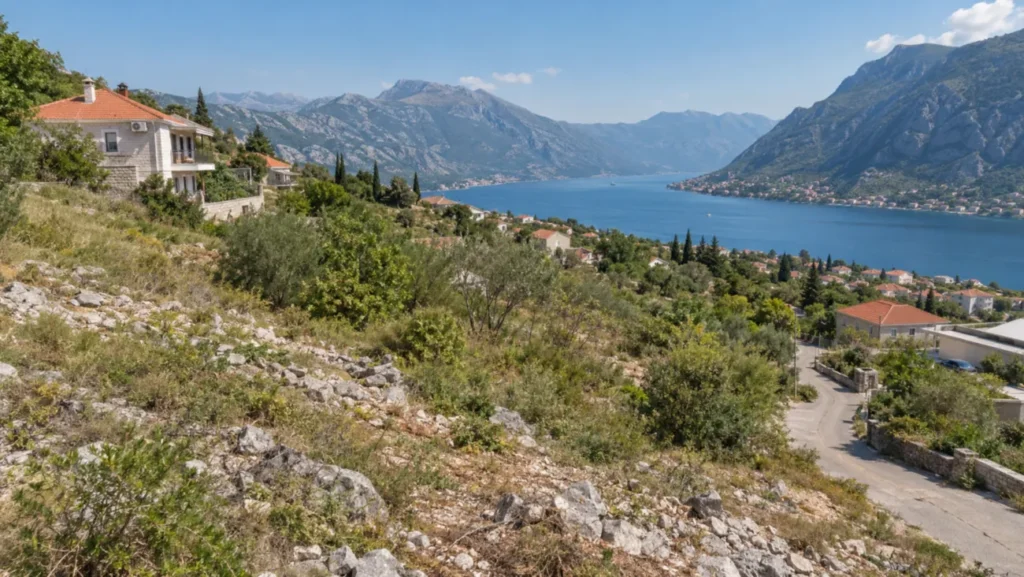
For buyers considering land, or properties with large unbuilt plots, this distinction is critical.
Owning a piece of land registered in the cadastre is a legal fact. Whether you can build what you intend on that land is a separate question — determined by planning classification, detailed urban conditions, access, utility availability and specific development rights. These are not the same thing, and in Montenegro the gap between them can be significant.
A land parcel might be:
- Agricultural land with restrictions on residential development
- Forest land with protective classifications that limit construction
- Within a coastal protection zone where development rules are particularly strict
- Urbanised in principle but subject to detailed planning conditions that restrict height, footprint, setback distances or permitted use
- Without legal road access, meaning any development would face practical and legal obstacles even if the plot itself is buildable
The practical scenario that buyers encounter: a plot appears on a hillside or near the coast with a good view, the price seems favourable, and the cadastral record shows it as a registered parcel. None of that confirms that the intended villa or house can be legally constructed there. Without obtaining and reviewing the applicable urban planning conditions and development documentation, the buyer has no reliable basis for that assumption.
Foreign buyers are subject to statutory restrictions on certain categories of land. Article 415 of Montenegro’s property law restricts foreign ownership of, among other categories, agricultural land, forests and forest land, islands and property within the specified land-border zone. A limited exception allows a foreign individual to acquire up to 5,000 m² of agricultural or forest land where a residential building on that land is also the subject of the transaction. The cadastral classification of the specific parcel should therefore be checked before signing.
Mistake 6: Relying on the Wrong People
Property transactions involve several participants, and they serve different interests. Confusion about roles is a surprisingly common source of buyer vulnerability.
The seller is the other party to the transaction. Their interest is completing the sale at the best price with the least disruption, not ensuring the buyer has understood the risks.
The listing agent may be engaged by the seller or otherwise have a commercial interest in the transaction completing. Ask whom the agent formally represents, who pays the fee, and whether the agent owes any contractual duties to you. Even a genuinely helpful agent is not structurally positioned to conduct independent legal due diligence for the buyer.
A buyer-side adviser or buyer’s agent, if engaged separately, changes this dynamic — but the buyer needs to be clear about who has engaged and paid that person.
An independent lawyer engaged by the buyer reviews documents and advises in the buyer’s interest. Independence depends on whom the lawyer acts for and whether any conflict of interest exists. The fact that a lawyer was recommended by an agent or seller is not by itself determinative — what matters is the scope of the mandate and whether a proper conflict check has been done.
A translator or interpreter confirms what a document says in another language. This is not the same as a legal review of whether the document is valid, complete or consistent with other records.
A Montenegrin notary performs statutory legality and authentication functions and has duties that include warning parties about certain legal defects and refusing acts that are expressly prohibited by law. However, the notary is impartial and does not replace a lawyer engaged to advise the buyer specifically on the buyer’s interests, negotiating position and transaction risks. Notarial authentication is not the same as independent due diligence conducted for the buyer.
| Person | What they can help with | What not to assume |
|---|---|---|
| Listing agent | Property search, viewings, negotiation/transaction coordination within their role | That they provide independent legal advice |
| Buyer’s lawyer | Title, contract, encumbrances, legal status and buyer-side legal advice within the agreed mandate | That a legal review is a structural/technical survey |
| Notary | Statutory notarial functions, authentication and legality checks required by law | That the notary negotiates exclusively for the buyer |
| Translator/interpreter | Accurate communication and translation | That translation is legal advice |
| Architect/engineer | Physical condition, alterations, buildability or technical feasibility within their expertise | That they establish clean legal title |
| Tax adviser/accountant | Transaction-specific tax consequences | That an agent’s cost estimate is tax advice |
Check who is actually allowed to act as an intermediary
Montenegro now regulates real estate intermediation under the Law on Intermediation in Real Estate Transactions and Leasing. The Ministry of Economic Development maintains a registration framework for intermediaries, including professional requirements for agents.
Before relying on an agency, ask for the legal name of the intermediary and verify its current registration status. Registration does not replace independent legal due diligence, but using an identifiable, properly registered intermediary gives the buyer an additional layer of accountability.
If conducting the transaction remotely or through a power of attorney arrangement, the choice of independent legal representation becomes even more important. “Buying property in Montenegro remotely” involves additional procedural considerations worth reviewing separately.
Mistake 7: Budgeting Only for the Purchase Price
The asking price of a property in Montenegro is not the total cost of acquiring it. Buyers who plan their budget around the listing price typically encounter additional costs that, depending on the transaction, can add a meaningful amount to the total.
Montenegro property transfer tax: the numbers buyers should budget for
For transactions that fall within the real estate transfer tax regime, Montenegro uses progressive rates:
| Taxable property value | Transfer tax |
|---|---|
| Up to €150,000 | 3% |
| €150,000.01–€500,000 | €4,500 + 5% of the amount above €150,000 |
| Above €500,000 | €22,000 + 6% of the amount above €500,000 |
These rates apply to the taxable value under the transfer-tax rules, not automatically to every property transaction. New construction and other VAT-taxable transactions can fall under a different tax treatment, so the applicable regime should be confirmed before budgeting.
Example: if the taxable value of a resale property is €200,000 and no exemption applies, the transfer tax under the progressive formula would be:
€4,500 + 5% × €50,000 = €7,000.
That is before notary fees, independent legal advice, translations, bank/FX costs, registration, furnishing or renovation.
The example illustrates the tax calculation only; it is not an estimate of the total closing cost for every €200,000 purchase.
The costs that commonly arise:
- Property transfer tax — generally applicable where the acquisition falls within the transfer-tax regime, subject to statutory exemptions. The governing legislation is the Law on Real Estate Transfer Tax; buyers should check the current version in force at the date of their transaction, including amendments published in Official Gazette No. 132/2026 in September 2026
- VAT — may apply to taxable supplies of newly constructed buildings and other transactions covered by VAT law; confirm the seller’s VAT status and whether the agreed price includes VAT
- Notary costs — set by notarial tariff; these vary with transaction value
- Independent legal review — the fee should be agreed in advance and weighed against the legal and financial risks of the specific transaction
- Certified translations and interpretation where required
- Bank and international transfer costs — foreign exchange conversion and international wire fees can be a significant line item on larger transactions
- Banking and source-of-funds checks — before the payment deadline, confirm with the banks involved what documentation they may require for a large international property transfer. Keep the purchase agreement, bank statements and other evidence supporting the source and purpose of the funds available. Do not assume that a large cross-border transfer will be processed instantly simply because the purchase contract has been signed.
- Registration and administrative costs — associated with registering ownership in the cadastre
- Renovation and furnishing — highly variable, but often underestimated for older properties
- Building service charges and maintenance — applicable to apartments and managed developments; these recur annually
- Parking or storage — these are sometimes sold separately from the main unit and not included in the headline price
- Ongoing property-related costs — utility connections, local levies and maintenance
- Montenegrin tax registration — foreign owners may need Montenegrin tax registration and the corresponding tax identification number for local tax obligations; the required timing should be confirmed for the particular transaction
The table below maps cost categories by transaction type:
| Cost category | Resale | New build / new construction | What to verify |
|---|---|---|---|
| Property transfer tax | Generally applicable where the acquisition falls within the transfer-tax regime, subject to statutory exemptions | Typically outside the transfer-tax regime where VAT applies; since 1 April 2026, building land subject to VAT is also excluded | Confirm which regime governs your transaction and check current statutory exemptions |
| VAT | Not typically applicable | May apply to taxable supplies of newly constructed property | Confirm seller’s VAT status; establish whether stated price is VAT-inclusive |
| Notary costs | Yes | Yes | Confirm current tariff for your transaction value |
| Independent legal review | Yes | Yes | Agree scope and fee before engagement |
| Translations / interpretation | As needed | As needed | Budget for certified translation where required |
| International transfer / FX | Yes | Yes | Check your bank’s rates; consider specialist FX |
| Cadastral registration | Yes | Yes | Confirm current administrative fee |
| Renovation / furnishing | Variable | Variable / often required | Survey condition before exchange |
| Building service charge | Where applicable | Where applicable | Request management accounts |
| Parking / storage | If sold separately | If sold separately | Confirm what is included in the price |
Mistake 8: Treating Off-Plan Like Resale
Buying a property that doesn’t yet exist — or is partway through construction — involves a different risk profile from buying an existing, registered unit. Many buyers approach off-plan transactions as if the main check is whether the floor plan looks right. The checks that matter most are mostly about the developer and the contract.
Resale due diligence focuses on an existing title and object. Off-plan due diligence must also test the developer, the project’s legal rights, the construction documentation and the contractual safeguards.
Before paying the first instalment on an off-plan project, a buyer should have established:
- The developer’s legal standing — is the company properly registered and in good standing?
- Land ownership or right to develop — does the developer own or have the legal right to build on the relevant parcel?
- Building permit — has a building permit been issued, or is the project being marketed before permits are in place?
- Exact unit specification — is the agreed specification (finishes, area, layout) clearly documented and contractually binding?
- Construction stage and programme — at what stage is construction, and what is the committed delivery date?
- Payment milestones — are staged payments linked to verifiable construction events, or only to calendar dates?
- Delay provisions — what does the contract say about delays, and what remedies exist for the buyer?
- Specification changes — can the developer change materials or specifications, and under what conditions?
- Handover conditions — what are the conditions for handover, and what happens if defects are present at completion?
- Recourse in the event of default — if the developer fails to deliver, what protections exist?
Some developers offer bank guarantees or escrow arrangements; others do not. A contract that commits the buyer to staged payments without meaningful protections for delay or developer default transfers significant risk to the buyer. Whether specific protections exist depends entirely on what the contract actually says — not on what is described in a sales brochure.
The off-plan market in Montenegro spans developments from experienced operators with strong track records to smaller projects where construction continuity is less certain. Developer due diligence matters independently from project due diligence.
New developments in Montenegro
Tivatот 42м²
Ulcinjот 31.77м² Tivatот 74.24м²


Mistake 9: Buying the View, Not the Location

Legal and financial risks get most of the attention in property guides, but poor location decisions cause a different kind of loss — one that shows up over time rather than at completion.
Montenegro’s best-known coastal areas — Budva, Kotor Bay, Tivat, Herceg Novi, Bar and others — each serve different buyer profiles. A property that works perfectly for two summer weeks may be genuinely inconvenient for full-time living, year-round rental or resale to a broad buyer pool.
The practical checks that buyers often skip:
- Road access — is the approach via a maintained road or a rough track? Does access become difficult in winter or after rainfall?
- Gradient and stairs — many desirable coastal properties involve significant vertical movement. This matters for older residents, families with young children and rental guests with luggage.
- Parking — in older coastal towns and hillside developments, parking is frequently inadequate or comes at additional cost. Verify before committing.
- Noise — position relative to roads, bars, nightclubs or construction sites can change dramatically between a summer viewing and a winter verification.
- Construction nearby — undeveloped plots adjacent to a property may carry active planning permissions. A buyer can verify planning applications at the local municipality.
- Winter access and services — some areas, particularly in the hills, may have reduced services or road conditions in winter; check this for the specific property, not as a general assumption.
- Distance on foot vs map distance — a property “five minutes from the sea” on a map may involve significant terrain. Check it on foot, not just on Google Maps.
- Humidity and sun exposure — north-facing properties in enclosed bays can be significantly darker and damper in winter than summer visits suggest.
- Rental seasonality — if rental income is part of the plan, some locations have a short letting season and limited off-season demand. This affects both income projections and resale liquidity.
| If you are buying for… | Check especially |
|---|---|
| Full-time living | Winter services, parking, walkability, schools/healthcare if relevant, heating/humidity |
| Holiday use | Airport access, beach/access route, parking, summer congestion |
| Short-term rental | Seasonality, management, building rules, realistic operating costs |
| Long-term rental | Year-round demand, services, transport, practical layout |
| Resale | Buyer pool, access, legal cleanliness, parking, micro-location |
| Land/development | Planning rights, road access, utilities, slope and construction feasibility |
Resale liquidity is worth particular attention. Well-established access and year-round infrastructure may broaden the potential buyer pool, but resale liquidity varies by micro-location, property type, price and market conditions, and should be checked against current local data rather than assumed from general observations.
Not sure where in Montenegro to buy?
Tell us your budget, intended use, preferred location and whether you plan to live, rent or resell. The property finder will narrow the search to options that fit those priorities.
Mistake 10: Confusing Ownership With Residency
A number of buyers arrive in Montenegro with the assumption that purchasing property automatically confers the right to live there long-term. This assumption can seriously disrupt immigration plans if it isn’t tested before the purchase is made.
Ownership of real estate is recognised under Montenegrin immigration rules as a possible legal basis for temporary residence, subject to the applicant meeting the current statutory requirements. Purchasing property does not itself automatically issue or guarantee a residence permit — the two are related but legally distinct questions.
The form of ownership and the immigration rules in force at the time of application should be checked before relying on a property purchase as the basis for residence. Rules in this area have evolved, and any buyer for whom residence status is a material goal should establish current requirements independently and verify them against their specific circumstances before choosing a property.
If residence is part of the plan, check the immigration requirements before you select the property — not after. The ownership structure and applicable procedures should be confirmed with reference to the rules in force at the time, not assumed from information that may be out of date.
For current information on the connection between property purchase and residence status, see “Montenegro Property Residence Permit“.
Documents to request before paying a deposit
For a typical resale purchase, the exact file depends on the property, but the initial document pack may include:
- current property/cadastral identification details sufficient for an independent list nepokretnosti check;
- seller identification and, where applicable, power of attorney;
- available construction and use documentation;
- documentation relating to later extensions or legalisation, where relevant;
- draft reservation/preliminary agreement;
- information on any mortgage that must be discharged;
- evidence relating to parking/storage if those are included in the sale;
- for land, the relevant planning and cadastral information;
- for a company seller/developer, company and project documentation relevant to its authority to sell.
The required documents vary by transaction; this is an initial request list rather than a universal statutory checklist.
The Checks That Matter Before You Buy
The section below organises the most important checks by transaction stage. This is a framework, not a replacement for advice specific to your property and situation.
Before paying a deposit
- Obtain an up-to-date list nepokretnosti (cadastral extract) directly — not from the seller
- Confirm the identity of the seller and their legal authority to sell (including any power of attorney)
- Establish whether the property is subject to any mortgage, lien or prohibition on disposal
- Check the legal status of the physical structure — is it fully permitted and registered, does it have a use permit, and are any extensions or alterations in legalisation process or unregistered?
- Understand the nature of the deposit payment in writing — whether it constitutes a kapara or another form of payment, and what the written agreement says about the consequences for each party in all scenarios
- Have the proposed deposit agreement reviewed by an independent lawyer before signing
- For off-plan: verify the project’s current permitting status before making any payment. Do not assume that marketing or reservations mean the required construction authorisation has been issued; if it has not, have the legal and contractual consequences independently reviewed before committing funds.
Before signing the final contract
- Obtain a fresh cadastral extract — not the one from three months ago
- Confirm that any agreed conditions (resolution of a legalisation issue, discharge of a mortgage, inclusion of parking) are fully completed and documented
- Review the full contract with your independent lawyer, including payment terms, representations and transfer timing
- For land: obtain and review the applicable planning conditions and confirm the development you intend is permitted; check the cadastral classification against the restrictions in Article 415 if you are a foreign buyer
- For off-plan: confirm all contractual protections (payment milestones, delay remedies, specification) are present and clearly worded
- Confirm total acquisition costs including tax, notary and all fees
Before transferring the balance
- Confirm the seller remains the registered owner and no new encumbrances have appeared
- Confirm that all conditions in the contract have been met
- Ensure the handover conditions (for new build or off-plan) are formally documented
The table below maps stages to the key checks, the parties typically involved, and signals that warrant closer attention.
| Stage | Key check | Who normally handles it | Red flag |
|---|---|---|---|
| Before deposit | Cadastral extract, title and encumbrances | Independent lawyer for the buyer | Seller provides extract; extract is old |
| Before deposit | Legal status of structure and alterations | Independent lawyer; physical inspection | No use permit; extensions not mentioned; legalisation status unclear |
| Before deposit | Seller identity and authority | Independent lawyer | POA without verified scope or validity |
| Before deposit | Nature and consequences of the payment | Independent lawyer | Payment described vaguely; no written terms |
| Before contract | Updated cadastral check | Independent lawyer | Changes from initial check |
| Before contract | Conditions fully met and documented | Independent lawyer | Verbal confirmation only |
| Before contract | Contract terms and payment milestones | Independent lawyer | Payment not linked to construction stages (off-plan) |
| Before contract | Cadastral classification for land (foreign buyers) | Independent lawyer | Agricultural, forest or border-zone land |
| Before balance | Ownership confirmed, no new encumbrances | Independent lawyer | Any new registration on the title |
| Before balance | Handover conditions met | Buyer’s inspection; independent lawyer | Developer refuses to document defects |
After signing and payment
Do not treat the transaction as administratively finished simply because the contract has been signed and the price paid. Confirm that the ownership-registration process has been initiated and completed as applicable, retain the final transaction documents and payment evidence, complete the handover record, and arrange any necessary changes to utilities and property management.
After registration, obtain an updated cadastral record showing the resulting ownership position and check it against the completed transaction.
Already considering a specific property?
Before you reserve it, make sure you know what documents need to be checked, what costs apply and which questions remain unanswered.
[Tell us what you’re looking at →]
Key Takeaways
- Sequence is the core protection. A prudent sequence is: identify a property → verify the relevant documents → complete independent legal checks → review the contractual terms → sign and transfer funds in accordance with the agreed transaction structure. Committing funds before the relevant checks and contractual protections are in place can materially increase risk.
- A fresh cadastral extract should be treated as an essential due-diligence check. The list nepokretnosti should be obtained independently and reviewed close to each key commitment point — deposit, contract and completion.
- Registered in the cadastre and fully legally compliant are not the same thing. Physical alterations, extensions and additional floors may not be reflected accurately in the registered record, and registration alone does not confirm that everything present is permitted.
- A property in legalisation is not the same as a legalised property. Montenegro’s legalisation law restricts the transfer of unlawfully constructed properties covered by the statutory prohibition, subject to specific exceptions. Do not assume that a property undergoing legalisation can currently be sold: confirm its cadastral annotations and transferability first.
- Land requires planning checks, not just title checks. Owning a plot registered in the cadastre does not mean you can build what you intend on it. Foreign buyers must also check the cadastral classification against the restrictions in Article 415 of Montenegro’s property law.
- Resale and off-plan transactions need different due diligence. An off-plan review must assess the developer, project rights and contractual protections — not just the title.
- Purchase price is not total acquisition cost. Property transfer tax (or VAT on qualifying supplies), notary fees, legal review, translations, bank transfer costs and registration fees all add to the total. Build these in before committing.
- The standard transaction participants do not collectively substitute for an independent lawyer acting for the buyer. The seller, listing agent and notary serve different functions. A Montenegrin notary has statutory duties but is impartial — not a buyer’s representative. Buyer-side legal advice requires someone engaged and paid by the buyer.
- Residency assumptions must be verified separately from ownership. Ownership of real estate is a recognised possible basis for temporary residence in Montenegro, but purchasing property does not automatically produce a residence permit.
Before You Commit Money
The risks described in this article are not arguments against buying property in Montenegro. They are the predictable points of failure when buyers bypass the standard protections — legal review, independent title verification, planning checks and proper contract terms.
Many of the serious problems a buyer can encounter fall into one of two categories: they didn’t know what to check, or they knew but left it until after money was committed. The first problem is solved by information; the second is a timing mistake.
The practical sequence that reduces risk is consistent regardless of property type: identify what you want → verify the documents with independent legal support → understand the full cost → review and negotiate the contract → transfer funds. Off-plan transactions add developer and construction risk to this sequence. Land transactions add planning, classification and access verification. Older properties add legalisation checks — and given the enforcement consequences that can follow from unresolved legalisation status, those checks matter before the deposit, not after.
Any transaction where the documentation is complex, incomplete or doesn’t match what’s physically present should be reviewed by a qualified Montenegro lawyer before any commitment. Independent legal review is one of the most important safeguards a foreign buyer can put in place before money moves.
 Real estate in Georgia
 Real estate in Cyprus
 Real estate in the UAE
 Real estate in Bali
 Real estate in Thailand
 Real estate in Spain
 Real estate in Saudi Arabia
 Real estate in Turkey
 Real estate in Zanzibar
 +382 60 099359
 hello@residence-estate.me
 The Old Bakery Residences, Budva 85310, Montenegro



 Get catalogue of TOP-7 objects