
 +382 60 099359




When you buy a newly built apartment in Montenegro, the standard VAT rate of 21% typically applies to the first taxable supply of that property — and when it does, the usual real estate transfer tax does not apply to the same transaction. As of October 2026, this distinction matters more than ever: recent legislative changes have extended VAT treatment to certain construction land transactions, and confusing VAT-inclusive with VAT-exclusive prices can result in substantial errors when calculating acquisition costs.
The central question is not simply whether a property looks new. It is whether the specific transaction qualifies as a first taxable supply under Montenegrin VAT law, and whether the price you have been quoted already includes that 21% or sits beneath it. Both answers need to be confirmed in writing before you pay a deposit.
This guide sets out how the rules work, where they differ from transfer tax, how to read a property price correctly, and what documents to review before signing anything.
Montenegro New-Build VAT in 2026: Key Figures
| Situation | Rate or treatment |
|---|---|
| Qualifying first taxable sale of a new-build apartment | 21% VAT |
| Real estate transfer tax on the same VAT-taxable supply | Generally not charged |
| Resale with a taxable value up to €150,000 | 3% |
| Resale valued above €150,000 and up to €500,000 | €4,500 + 5% of the excess above €150,000 |
| Resale valued above €500,000 | €22,000 + 6% of the excess above €500,000 |
| New-build price of €200,000 excluding VAT | €242,000 including 21% VAT |
| New-build price of €200,000 including VAT | €200,000 total; approximately €34,711 is VAT |
| Notary fees | Based on the official 2026 tariff; additional services and VAT may apply |
| Annual property tax after purchase | Generally 0.25–1% of the assessed value under the ordinary framework; specific property categories and municipal rules may differ |
Important: A newly completed apartment is not automatically subject to VAT merely because it is new. Confirm the seller’s VAT status, the transaction history and the written price breakdown before paying a deposit.
Figures refer to the general framework as of October 2026. Transaction-specific exemptions, valuation rules and other charges must be checked separately.
How New-Build VAT Works
VAT — value added tax — is a consumption tax charged on the supply of goods and services by registered taxable persons. In the context of property, it applies when a VAT-registered seller makes a taxable supply of a qualifying asset. For newly built residential property in Montenegro, the first taxable transfer is generally treated as a VAT-liable transaction, rather than one subject to real estate transfer tax.
This is an important legal distinction, and it depends on more than who the seller happens to be. VAT treatment depends on whether the transaction constitutes a taxable first transfer under Montenegrin law, taking into account the seller’s status, the property’s transaction history and the applicable statutory rules. A building completed some time ago could still be the subject of its first taxable supply if it has not previously been transferred in a qualifying transaction. Conversely, an apartment marketed as a “new-build” might have already passed through one registered sale, placing the next transaction outside the typical VAT regime.
The seller’s VAT status is an important factor, but it should be assessed alongside the legal nature of the supply and any applicable registration obligations. A private individual reselling a flat they purchased from a developer is generally not making a VAT-liable supply. A developer or construction company completing the sale of units they have built is typically acting as a taxable person and is obliged to account for VAT on qualifying supplies. The economic effect — who ends up bearing the cost — may be embedded in the price from the outset, but the legal obligation to account for VAT sits with the seller, not the buyer. These are two separate things, and conflating them leads to misunderstandings about who owes what to whom.
Several factors can alter the tax qualification: the nature of the selling entity, how the contract is structured, whether the property has been used commercially before the sale, and what documentation the seller provides. No single indicator — not the newness of the finish, not the presence of a developer’s brochure — substitutes for verifying the tax status of the transaction in writing.
Typical VAT treatment by transaction type
| Transaction type | Typical tax treatment | What to verify |
|---|---|---|
| Qualifying taxable first supply by a developer | Generally 21% VAT rather than real estate transfer tax, subject to verification of the transaction | Developer’s VAT registration; invoice; contract price basis |
| Resale by a private individual | Real estate transfer tax at progressive rate | Whether any prior VAT sale occurred; market valuation; seller’s legal status |
| Off-plan purchase direct from developer | Advance payments for a taxable property supply may trigger VAT accounting when received, subject to applicable invoicing and transitional rules | Payment schedule, VAT status of each stage, contract terms |
| Sale of qualifying construction land (post-April 2026) | VAT may apply following 2026 amendments | Authorisation for construction under applicable legislation; whether transitional rules apply |
| Subsequent sale by a registered company (non-developer) | Requires separate assessment of transaction history and seller’s VAT position; transfer tax should not be assumed solely because the seller is not the original developer | Seller’s legal and tax status; prior transaction history; independent legal advice |
When Does 21% VAT Apply?
The standard rate of 21% applies to taxable supplies made by registered taxable persons. For property, this generally means the first taxable transfer of a newly built unit by an entity acting in a qualifying commercial capacity. The sale of a completed apartment by a VAT-registered developer is the paradigm case — buying a flat in a new complex in Budva, Tivat, Kotor, or Herceg Novi directly from the builder typically places the transaction in this category.
What the law does not do is apply VAT to every flat that happens to look new. Consider a scenario in which a company purchases apartments from a developer at completion, paying VAT on those acquisitions, and then resells one unit to a private buyer at a later date. That second sale requires a separate assessment of the property’s transaction history and the selling company’s VAT position. Transfer tax should not be assumed solely because the seller is not the original developer, but the reverse should not be assumed either. The applicable tax treatment follows from the legal and factual analysis, not from the physical condition of the property.
Similarly, buying from a seller who is not VAT-registered — for instance, a private individual who originally bought as an investment — generally falls outside the VAT framework. The determining factors are the seller’s status, the nature of the transaction, and the property’s prior transaction history, not the external condition of the property. This is why it is not safe to rely on marketing language such as “newly completed” or “direct from developer” as confirmation of the tax treatment.
There is also a category of purchase that falls between straightforward developer sales and clear resales: transactions structured through special-purpose vehicles, assignments of preliminary contracts before construction completes, or sales in which a third party is the legal seller while the developer remains commercially involved. These arrangements require specific legal analysis before their VAT treatment can be determined, and should not be treated as straightforward first-supply transactions without confirmation.
Explore New-Build Developments in Montenegro


 Bar
 от 37,5м²
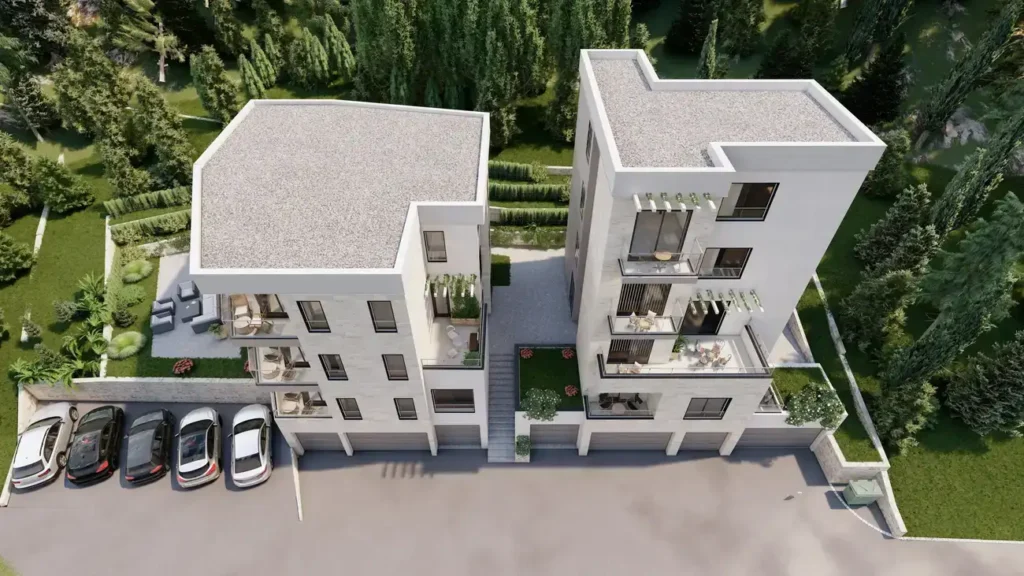 Tivatот 42м²

 Budvaот 63м²
 Ulcinjот 31.77м²
 Budvaот 38.52м²
VAT vs Property Transfer Tax
Understanding which of these two taxes applies to your transaction is arguably the most practically important question for any buyer.
As a general rule: when a property transaction is subject to VAT, real estate transfer tax does not apply to that same supply. The two taxes do not typically stack on a single qualifying transaction.
Real estate transfer tax (porez na prenos nepokretnosti) applies to transfers of property that fall outside the VAT system — primarily resales between private individuals, transfers by non-registered sellers, and other transactions that do not qualify as a first taxable supply. Montenegro introduced a progressive transfer tax scale from 1 January 2024. The progressive rates remain unchanged as of October 2026. Further amendments in March and September 2026 addressed other aspects of the transfer-tax framework, including the interaction with VAT on certain transactions and adjustments to specific exemptions, without altering the rates themselves. The current structure is set out in the updated Law on Real Estate Transfer Tax.
The progressive rates work as follows:
- Up to €150,000: 3% of the taxable value
- Above €150,000 and up to €500,000: €4,500 plus 5% of the excess above €150,000
- Above €500,000: €22,000 plus 6% of the excess above €500,000
The taxable base for transfer tax is the market value as assessed by the tax authority, which may differ from the declared contract price. Buyers who purchase at below-market prices, or in transactions where the declared price is questioned, may find the actual transfer tax calculated on a higher figure.
Worked examples at selected taxable bases:
- At €200,000: €4,500 + 5% × €50,000 = €7,000 transfer tax
- At €300,000: €4,500 + 5% × €150,000 = €12,000 transfer tax
- At €600,000: €22,000 + 6% × €100,000 = €28,000 transfer tax
These are illustrative calculations for the stated tax bases and do not constitute tax advice for any specific transaction.
VAT vs transfer tax — key comparison
| Scenario | Relevant tax | Tax basis | Who handles the tax | Key documents |
|---|---|---|---|---|
| Qualifying taxable first supply by VAT-registered developer | VAT at 21% | Taxable consideration determined under VAT rules, subject to any applicable adjustments | Seller (developer) accounts for and pays VAT | VAT invoice, purchase contract, developer’s VAT certificate |
| Resale by private individual | Real estate transfer tax (progressive) | Market value as assessed by tax authority | Buyer pays; notary and tax authority involved | Transfer tax assessment, contract, market valuation |
| Subsequent sale by registered company | Requires separate analysis; see professional advice | Determined by applicable rules | Depends on outcome of legal analysis | Seller’s status, prior transaction history |
| Construction land with qualifying authorisation (post-April 2026) | VAT may apply | Determined under applicable VAT rules | Seller accounts; buyer should verify | Authorising construction document, contract, VAT registration |
This comparison also makes clear that new-build purchases are not automatically cheaper from a tax perspective. If a qualifying new-build transaction is priced at €300,000 excluding VAT, applying the standard 21% rate produces €63,000 of VAT and a total of €363,000, before other costs. A buyer purchasing a resale flat at a €300,000 assessed value pays €12,000 in transfer tax — a materially different total. Comparing headline prices without knowing which tax applies and whether VAT is already included leads to serious miscalculation.
For a broader overview of how property taxes interact across different transaction types in Montenegro, see our guide to “Montenegro property taxes“.
New-Build vs Resale: What Does the Buyer Actually Pay?
Two apartments advertised at the same price may have different acquisition costs depending on whether VAT is already included and which tax applies.
| Cost component | New-build: VAT included | New-build: VAT excluded | Resale property |
|---|---|---|---|
| Advertised price | €200,000 | €200,000 | €200,000 |
| VAT added to advertised price | €0 | €42,000 | €0 |
| Transfer tax | €0* | €0* | €7,000** |
| Price plus applicable transaction tax | €200,000 | €242,000 | €207,000 |
| Notary, legal and registration costs | Additional | Additional | Additional |
Assumes a qualifying VAT-taxable first supply that is not subject to transfer tax.
*Assumes an assessed taxable value of €200,000 and no applicable transfer-tax exemption.
The comparison does not suggest that resale property is always cheaper. The new-build advertised price may already include VAT, while the resale property’s condition, renovation requirements and other expenses can materially change the overall cost.
Buyer takeaway: Compare the final contractual price, applicable tax treatment and additional acquisition costs — not just the advertised property price.
Know Your Total Budget Before You Buy
Tell us your preferred location, budget and property type. We can help you shortlist apartments and obtain written price breakdowns from sellers.
Find Apartments Within My Budget
Is VAT Included in the Price?
Whether VAT is included in the quoted price is a key question buyers should resolve before paying a deposit. Developers may advertise property prices on a VAT-inclusive or VAT-exclusive basis, and these are not interchangeable. The difference on a €200,000 net price is €42,000 — an amount that significantly alters affordability calculations, mortgage planning, and the final funds required to complete.
Three pricing terms to understand:
- Net price (VAT-exclusive): the amount before VAT is added.
- Gross price (VAT-inclusive): the total price including applicable VAT.
- Final agreed purchase price: the amount payable under the contract, which should clearly identify any included or additional VAT and compulsory charges.

Three pricing scenarios in practice:
Scenario A — price quoted exclusive of VAT: Net price: €200,000. VAT at 21%: €42,000. Total payable: €242,000. The buyer pays both figures.
Scenario B — price quoted inclusive of VAT at a higher total: Gross price: €242,000. This already contains VAT. Net component: €200,000. VAT component: €42,000. The buyer does not pay a further €42,000 on top of €242,000.
Scenario C — price quoted inclusive of VAT at a round number: Gross price: €200,000. This is the total inclusive figure. To extract the VAT amount, the correct formula is: VAT included = Gross price × 21 ÷ 121 = €200,000 × 21 ÷ 121 ≈ €34,711 Net component: ≈ €165,289. The buyer does not owe any further VAT on top of €200,000.
A common and costly error in Scenario C is to calculate €200,000 × 21% = €42,000 and conclude that the net price is €158,000. That method applies the wrong formula. The 21% rate applies to the net price, not the gross — so extracting embedded VAT from a gross figure always requires the 21 ÷ 121 formula.
VAT pricing scenarios for a Montenegro new-build
| Advertised price | VAT treatment | Net price | VAT amount | Total payable |
|---|---|---|---|---|
| €200,000 | Exclusive of VAT (VAT added on top) | €200,000 | €42,000 | €242,000 |
| €242,000 | Inclusive of VAT | €200,000 | €42,000 | €242,000 |
| €200,000 | Inclusive of VAT | ≈€165,289 | ≈€34,711 | €200,000 |
The wording to look for in a commercial offer or preliminary contract includes: “VAT included”, “cijene su sa PDV-om” (prices include VAT in Montenegrin), or conversely “plus VAT”, “bez PDV-a” (excluding VAT), or “VAT will be charged separately”. If none of these appear, the document is ambiguous and requires written clarification before any payment is made.
Before transferring any deposit, confirm in writing whether the stated price includes or excludes VAT. If the commercial offer or reservation agreement does not specify this clearly, request written confirmation of the VAT treatment and a clear price breakdown before making any payment. Ensure that the appropriate tax documentation will be issued when required.
Subject: VAT confirmation for apartment purchase
Hello,
Before proceeding with the reservation, please confirm the following details in writing:
- Is the quoted purchase price inclusive or exclusive of Montenegro VAT?
- What is the total amount payable for the apartment, including applicable VAT?
- What is the legal name and VAT identification number of the selling entity?
- Is this transaction treated as a qualifying first taxable supply?
- What VAT documentation will be provided for advance payments and the final sale?
- Are parking, storage, connection fees or other compulsory charges included in the quoted price?
Please also provide the current cadastral extract and the draft purchase or preliminary agreement for independent review.
Thank you.
Looking for a new-build apartment in Montenegro? The Residence can help you explore suitable properties and compare their advertised prices before you arrange an independent legal and tax review. Find your ideal property.
VAT on Off-Plan Apartments
Buying off-plan — purchasing before or during construction — introduces additional complexity around when VAT obligations arise and how payments are structured throughout the process.
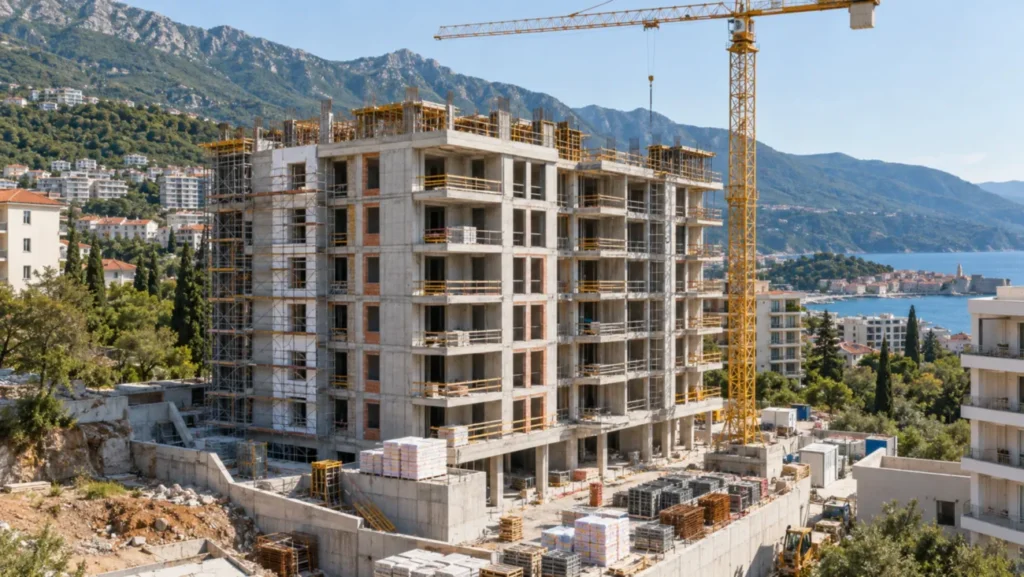
The typical off-plan purchase in Montenegro involves a reservation agreement, followed by a preliminary contract (predugovor) that sets out the payment schedule, and a final notarised purchase agreement upon or near completion. Staged payments are common: a deposit at reservation, further instalments during construction, and a final payment on handover.
In general terms, advance payments for a taxable property supply may trigger VAT accounting when received, subject to the applicable invoicing and transitional rules. This means that deposits and stage payments to a VAT-registered developer are likely to be within the VAT framework from the outset. Ask the developer and your accountant to confirm which VAT documents must be issued for each advance payment and the final supply — the distinction between a document issued for an advance and a final VAT invoice matters for your records and for any deduction entitlement analysis.
The overall purchase price should be stated on a clear VAT-inclusive or VAT-exclusive basis from the outset. If the preliminary contract quotes a VAT-exclusive figure, the total cost to the buyer is higher than that figure by 21%. If it quotes a VAT-inclusive figure, the buyer should not expect additional VAT charges on top of the agreed total. Discrepancies between how the reservation agreement and the preliminary contract describe the price are a warning sign that requires legal clarification before proceeding.
The 2026 amendments to the VAT law introduced transitional provisions for qualifying advance payments received before 1 April 2026 in relation to construction land transactions and first transfers of newly constructed buildings. The new rules do not apply to those earlier qualifying advance payments. For the portion of the price covered by pre-April payments, no VAT adjustment is required merely because the final invoice is issued after that date. Buyers who signed preliminary agreements and made deposits before 1 April 2026 should obtain specific legal advice before drawing any conclusions about the treatment of those earlier amounts.
Off-plan purchase VAT checklist:
- Confirm in writing whether the total purchase price in the preliminary contract is stated inclusive or exclusive of VAT — not verbally.
- Request written confirmation of the VAT treatment and a clear price breakdown from the developer before paying the reservation deposit.
- Check that the developer is registered for VAT and obtain their VAT identification number.
- Ask the developer and your accountant to confirm which VAT documents must be issued for each stage payment and at final transfer.
- Clarify with your legal adviser whether transitional provisions affect any payment already made before 1 April 2026 in connection with the transaction.
- Confirm the handover and ownership registration conditions, and what documentation will accompany the final payment and transfer of title.
Compare Apartments Under Construction



Construction Land VAT Changes in 2026
Prior to 2026, the VAT treatment of construction land in Montenegro created inconsistencies in how development plot transactions were handled. The legislative amendments published in the Official Gazette of Montenegro No. 012/26 on 6 February 2026 addressed this directly, with practical application beginning 1 April 2026.
The amendments to the Law on Value Added Tax brought certain transactions involving construction land into the scope of VAT-liable supplies. For the purposes of these amendments, the relevant distinction is whether the land has an authorisation permitting construction under the applicable Montenegrin construction legislation. Buyers should verify the exact authorising document and the tax status of the proposed supply — not simply whether a document with the label “building permit” exists. Land without such authorisation in place does not automatically fall within the new VAT provisions.
The April 2026 change does not mean that all land sales in Montenegro now attract VAT. For identifying qualifying construction land under the 2026 amendments, a key condition is whether an authorisation permitting construction has been issued under the applicable Montenegrin legislation. The VAT treatment of the transaction must also be assessed in light of the seller’s status and the relevant statutory requirements.
This distinction matters in practice. A transfer of agricultural or undeveloped land without a qualifying construction authorisation may fall within the real estate transfer tax regime rather than the new VAT treatment for qualifying construction land; the applicable tax and any exemptions must be assessed for the specific transaction. A buyer purchasing a plot with a valid authorising document — whether as a standalone transaction or as part of a broader acquisition from a developer — now needs to consider whether VAT applies to the land component and how that affects the overall price structure.
For developers, the change affects how the price of a new development is structured, since land with the qualifying authorisation may now fall within the VAT chain from an earlier stage of the project. For buyers, it means that the land element within a broader off-plan or new-build purchase may carry different tax treatment depending on how the transaction is documented and structured. The financial impact on buyers depends on how the developer structures and prices the transaction, including whether the quoted price already incorporates the applicable VAT.
The corresponding amendment to the Real Estate Transfer Tax Law was published in Official Gazette No. 33/2026 on 10 March 2026. The related VAT treatment of qualifying construction land applies from 1 April 2026, coordinating the two tax regimes to avoid double taxation on qualifying construction land transactions. Analysis published by KPMG in March 2026 confirmed the April application date and the transitional treatment of advance payments received before that date.
Does the Land Value Form Part of the VAT Base?
The 2026 changes also affected the rules used to determine the VAT base. The amendment to the VAT implementing regulations, published in Official Gazette No. 81/2026 on 12 June 2026, removed an earlier provision excluding land value and municipal land-development compensation from the VAT base.
This matters where a developer’s contract separately identifies the apartment, the underlying land or development-related charges. Buyers should not assume that a separately itemised amount is automatically outside the VAT calculation.
Ask a Montenegrin tax adviser to confirm the taxable consideration for the actual transaction, including how any separately charged land or development-related amounts are treated.
Transitional rules are particularly relevant for buyers who paid deposits before 1 April 2026 on deals involving qualifying construction land or first transfers of newly constructed buildings. The new rules do not apply to those earlier qualifying payments, and no VAT adjustment arises merely because the final invoice is issued after 1 April 2026. Whether specific payments benefit from the transitional protection depends on the contractual and factual circumstances; professional advice is required before drawing conclusions either way.
For buyers interested in acquiring land with development potential, see our overview of “Buying land in Montenegro as a foreigner“.
Can Foreign Buyers Recover VAT?
Foreign nationality alone confers no automatic right to a VAT refund on a residential property purchase in Montenegro. This is a common misconception, and one that occasionally causes buyers to underestimate their actual acquisition cost.
The right to deduct input VAT belongs to VAT-registered taxable persons who use the acquired asset in their business activities in a way that satisfies the relevant statutory conditions. A private individual purchasing an apartment for personal use or as a holiday home does not fall within this category. A privately held investment property does not automatically qualify for input VAT deduction either; eligibility depends on the owner’s taxable activities and applicable statutory conditions. For property acquired exclusively for personal use, input VAT is generally not deductible. Where a privately owned property is used in qualifying taxable business activities, any entitlement to deduct input VAT must be assessed separately under Montenegrin VAT law.
For buyers who intend to use a property for commercial purposes — for instance, through a short-term rental operation structured as a registered Montenegrin business — the question of input VAT deduction is more nuanced. Whether input VAT can be deducted depends on the business’s registered activities, its VAT registration status, the use to which the property is put, and other legal conditions under Montenegrin VAT law. Input VAT deduction may be unavailable, wholly or partly, where the acquisition does not meet the relevant statutory conditions, and the analysis must be done on a transaction-by-transaction basis with qualified professional input.
A common error involves the assumption that purchasing property through a foreign or domestic company automatically results in a VAT refund. Consider a buyer who registers a company in Montenegro, acquires an apartment through it, and expects the company to reclaim the 21% VAT from the tax authority. In reality, if the company is not conducting taxable business activities for which input VAT deduction is permitted, or if the property is used for purposes that do not qualify, the deduction will not be available. The effective cost remains the gross price including VAT, and the company structure adds administrative cost without the anticipated tax benefit.
Do not treat a company purchase structure as a mechanism for reducing VAT cost without specific written confirmation from a Montenegrin tax adviser that input VAT recovery is available in your particular situation.
Other Costs of Buying a New Build
The purchase price and VAT are the largest components of acquisition cost, but several further expenses arise in a Montenegrin property transaction and should be factored in from the outset.
Notary fees are payable for the preparation and certification of the purchase contract. A notary is mandatory for a valid real estate transaction in Montenegro. Fees are governed by the Montenegrin notarial tariff, including the revised tariff published in Official Gazette No. 49/2026, which applies from 9 April 2026. The amount depends on the relevant tariff category, transaction value and applicable additional services. Request an itemised estimate, including VAT on the notarial service itself, before signing.
Example of a notary fee under the 2026 tariff
Under the tariff published in Official Gazette No. 49/2026, a standard notarial deed involving property valued at €200,000 has a base tariff fee of approximately €558, before VAT and any additional chargeable services. Applying 21% VAT to this base fee gives approximately €675.18.
This is an illustration of the relevant tariff calculation, not a guaranteed final notary quotation. The form of the notarial act, additional services and other applicable tariff provisions may affect the actual invoice.
Ask the notary for a written, itemised estimate before signing.
Independent legal advice should be treated as a non-negotiable cost. Your legal representative — separate from the notary — reviews title, searches for encumbrances, examines the seller’s authority to sell, advises on contract terms, and ensures that the VAT treatment and price basis are correctly documented. Fees vary by firm and the complexity of the transaction.
Certified document translation costs arise when official documentation needs to be rendered into a language you understand, or when Montenegrin-language contracts require certified translation for your own records or for use abroad.
Cadastre registration charges should be verified against the applicable fee schedule for the specific filing, as the applicable amounts depend on the registration type and the transaction in question.
Bank and international transfer fees can be significant for buyers moving large sums from outside Montenegro. Both your home bank and correspondent or receiving banks may apply fees or exchange rate margins; obtain a written breakdown before initiating transfers.
Handover and initial setup costs — utility transfer registrations, any fitting-out works, appliances, furniture — are not formally part of the acquisition but should be budgeted separately, particularly in newly built properties delivered in shell-and-core or partially fitted condition.
Contractual ancillary payments: some developer contracts bill for parking spaces, storage units, or communal infrastructure separately from the headline apartment price. Review all contract schedules carefully, not just the main price clause.
Annual property tax after purchase: Under Montenegro’s general property-tax framework, the ordinary rate commonly falls between 0.25% and 1% of the assessed property value. Different rules or rates may apply to certain property categories, including holiday homes, and municipalities determine the applicable assessment. This annual charge is separate from the VAT or transfer tax associated with acquiring the property.
For example, applying an illustrative 0.25–1% rate to an assessed value of €200,000 produces €500–€2,000 per year. This is not a quotation for a particular apartment; the local assessment and applicable property classification must be checked.
For further details, see our guide to Montenegro property taxes.
For a step-by-step guide to the full purchase process, see “How to buy property in Montenegro“.
Documents to Check Before Signing
Differences between marketing materials and legally verified project documentation can create significant buyer risks. A structured review by an independent Montenegrin lawyer is an important measure for reducing legal and transactional risks before the preliminary contract is signed.

Key documents for a new-build purchase
| Document | Why it matters | Warning sign | Who should verify it |
|---|---|---|---|
| Seller’s company registration (CRPS extract) | Confirms legal identity, registered activity, and authority to contract | Discrepancy between seller named in contract and registry record | Your independent lawyer |
| VAT registration certificate | Confirms the seller is a registered taxable person; supports VAT treatment | Missing, expired, or inconsistent with claimed VAT status | Your lawyer; request from seller directly |
| VAT invoice or advance tax document | Documents the VAT amount for each qualifying payment; required for tax records | No documentation issued; amounts inconsistent with contract price basis | Your lawyer and, if applicable, your accountant |
| Purchase contract | Sets out price basis (inclusive/exclusive VAT), payment schedule, handover terms, and recourse | VAT treatment unspecified; price basis ambiguous; key terms absent | Your lawyer before signing |
| Cadastral extract (list nepokretnosti) | Shows current registered ownership and any encumbrances or liens | Outstanding developer mortgage; owner differs from contracting seller | Your lawyer; checked directly at cadastre |
| Building authorisation document | Establishes the approved scope of construction, subject to verification of its validity, any project amendments, and compliance with applicable requirements | Missing, issued for a different scope, or its legal validity is unclear | Your lawyer; local municipality |
| Completion or occupancy documentation | Verify whether it is required for the particular building and whether the relevant approval or completion procedure has been satisfied, taking into account the applicable regulatory regime | Required documentation is missing and the seller cannot explain the legal basis for lawful use of the completed property | Your lawyer |
| Developer mortgage release plan | Shows how existing developer financing over your specific unit will be discharged | No clear plan or timeline; buyer potentially assumes encumbrance | Your lawyer; independent confirmation from lender |
| Payment schedule and bank account details | Confirms who receives payments, in what amounts, and when | Payments directed to a third party not clearly connected to the seller | Your lawyer; independent verification of beneficiary |
| Ownership registration timeline | Sets out when and how your title will be registered at the cadastre | Vague or open-ended; registration responsibility unassigned | Your lawyer |
Five Steps to Confirm VAT Before Buying a New-Build Apartment
- Identify the legal seller. Obtain the registered company details and confirm that the entity signing the contract has authority to sell the apartment.
- Confirm the VAT treatment. Request written confirmation of whether the transaction is a qualifying taxable first supply and whether the quoted price includes VAT.
- Check the property records. Obtain a current cadastral extract and verify ownership, mortgages, construction authorisations and the legal status of the unit.
- Review the contract and payment schedule. Have an independent lawyer check the total price, advance-payment terms, applicable VAT documentation, refunds, deadlines and mortgage-release arrangements.
- Complete and verify ownership registration. Follow the required notarial and cadastral procedures and obtain confirmation that your ownership has been registered.
Do not release substantial funds merely because the seller has supplied a VAT invoice. Tax documentation and legal title verification are separate checks.
The presence of a VAT invoice, on its own, does not confirm that the property has a clean legal title, a valid completion status, or that all encumbrances over the unit have been discharged. Each document in the table serves a distinct verification purpose; obtaining one does not substitute for obtaining the others.
For a comprehensive framework covering pre-purchase investigation in Montenegro, see our guide to “Montenegro real estate due diligence“.
Need Help Comparing Verified Property Information?
We can help you identify suitable properties and collect available documentation from sellers for your independent lawyer’s review.
Get a Personal Property Shortlist
Common VAT Mistakes
The following are illustrative mistakes that buyers should take care to avoid. Careful preparation can help buyers reduce the likelihood of these mistakes, though no single step eliminates all transactional risk.
1. Adding VAT to a price that already includes it. A developer advertises an apartment at €200,000 inclusive of VAT. The buyer assumes VAT will be charged separately and mentally adds 21%, arriving at a fictional total of €242,000. The actual amount payable is €200,000. This error distorts affordability calculations and occasionally leads buyers to reject viable properties or approach financing incorrectly.
2. Using the wrong formula to extract embedded VAT. A buyer is told the price is €200,000 inclusive of VAT and wants to know the VAT component. They calculate €200,000 × 21% = €42,000 and conclude the net price is €158,000. The correct calculation is €200,000 × 21 ÷ 121 ≈ €34,711 VAT, giving a net price of ≈€165,289. Applying 21% to the gross figure rather than using the 21/121 formula overstates the VAT component and understates the net price.
3. Assuming any recently completed apartment is automatically a first VAT-taxable supply. As explained above, the first taxable supply test depends on the seller’s status, the legal nature of the transaction, and the property’s prior transaction history — not on when the building was finished. An apartment completed recently, sold by a party who is not the original developer, may attract transfer tax rather than VAT. These must be treated as hypothetical outcomes to verify, not universal tax rules.
4. Ignoring the seller’s legal and tax status. A buyer proceeds on the assumption that buying from an entity described as a “developer” guarantees VAT treatment, without verifying whether that entity is actually registered for VAT or has clear authority to sell the specific unit. A seller’s lack of VAT registration is a warning sign that requires further investigation: buyers should verify whether the seller is required to register for VAT, whether the transaction is taxable, and whether the appropriate tax documentation can lawfully be issued.
5. Expecting an automatic VAT refund based on purchasing through a company. As discussed in the recovery section, input VAT deduction may be unavailable, wholly or partly, where the acquisition does not meet the relevant statutory conditions. Purchasing through a company without a qualified legal and tax assessment of the specific situation is a mistake that can result in unexpected and unrecoverable cost.
6. Paying a deposit before confirming the total price and tax treatment. A buyer pays a €20,000 reservation deposit, only to discover at preliminary contract stage that the €200,000 headline price was exclusive of VAT. The total payable is €242,000 — €42,000 more than the buyer budgeted. Obtaining written clarification before payment can reduce the risk of unexpected VAT charges and pricing disputes at a later stage.
For a broader overview of errors to avoid across the full acquisition process, see our guide on “Mistakes buying property in Montenegro“.
Final Thoughts
Buying a new-build property in Montenegro requires comparing the total acquisition cost, not just the price in the developer’s brochure. That means establishing whether 21% VAT is already embedded in the figure you have been quoted, understanding which tax applies to your specific transaction, and accounting for notary fees, legal costs, and registration charges alongside the headline price.
The core principles are clear enough once they are set out: VAT applies to the first taxable supply by a qualifying seller and transfer tax does not then apply to the same transaction; a VAT-inclusive price does not attract further VAT on top; foreign buyers have no automatic right to recover input VAT; and the 2026 amendments around construction land affect transactions involving qualifying plots from April of this year onwards.
What varies is how those principles apply to any given deal. The correct tax treatment depends on the seller’s legal and tax status, the contract structure, the nature of the property, and the specific transaction history. Confirm the VAT treatment of your purchase in writing before paying any deposit, and arrange an independent legal and tax review by a qualified Montenegrin professional before signing a binding agreement. No reservation form, commercial offer, or developer presentation replaces that step.
This article provides general information about Montenegro’s VAT and property transfer tax framework as of October 2026 and does not constitute legal, tax, or financial advice. Tax rules may be amended, and their application depends on the specific facts of each transaction. Before purchasing property in Montenegro, obtain independent advice from a qualified Montenegrin lawyer and, where appropriate, a registered tax adviser. The Residence does not provide legal or tax services.
 Real estate in Georgia
 Real estate in Cyprus
 Real estate in the UAE
 Real estate in Bali
 Real estate in Thailand
 Real estate in Spain
 Real estate in Saudi Arabia
 Real estate in Turkey
 Real estate in Zanzibar
 +382 60 099359
 hello@residence-estate.me
 The Old Bakery Residences, Budva 85310, Montenegro



 Get catalogue of TOP-7 objects