
 +382 60 099359




Two buyers agree on the same advertised price — €250,000. One is purchasing a new apartment directly from a developer; the other is buying a similar flat from a private owner. Before either transaction completes, the second buyer faces an additional €9,500 in property transfer tax. The first buyer, provided the sale qualifies as a VAT-taxable developer transaction, pays no separate transfer tax on top — because VAT at 21% is already included in the quoted price in this example. Buyers must confirm whether a developer’s actual quotation is VAT-inclusive before relying on any stated figure.
That difference is the central tax issue when comparing new-build and resale property in Montenegro. A purchase from a VAT-registered developer on a qualifying first sale is generally treated as a supply subject to VAT (locally PDV — porez na dodatu vrijednost) at 21%, not as a transfer of ownership for the purposes of real estate transfer tax. A resale transaction — where an existing owner, whether individual or company, sells a property that has already been in private hands — ordinarily attracts progressive real estate transfer tax ranging from 3% to 6% of the taxable market value. Same price, different tax treatment, and a meaningful difference in your total acquisition cost.
This guide explains both regimes in detail, shows how to calculate what you would actually pay, and identifies the questions to ask before you sign anything.
Montenegro property taxes at a glance (2026)
| Tax or cost | New build | Resale |
|---|---|---|
| VAT on qualifying developer sale | 21%, check whether included in price | Usually not applicable to an ordinary private resale |
| Real estate transfer tax | Not charged where the sale qualifies for VAT treatment | 3%–6%, progressive |
| Transfer tax on €250,000 | €0 where VAT treatment applies | €9,500 |
| Transfer tax on €400,000 | €0 where VAT treatment applies | €17,000 |
| Notary | Regulated tariff | Regulated tariff |
| Legal review | Recommended | Recommended |
| Registration and translation | Additional costs | Additional costs |
| Annual property tax | Generally 0.25%–1%; special rates may apply | Same rules |
| Rental income and eventual resale | Separate tax obligations | Separate tax obligations |
The figures assume that the new-build transaction qualifies for VAT treatment, the resale has no statutory exemption, and the taxable market value equals the stated purchase price. Annual property tax depends on the municipality and property classification.
New Build vs Resale: Tax Comparison
The table below sets out the core differences. It is a starting point, not a definitive answer for any individual transaction, because the applicable tax depends on the legal nature of the specific sale — not simply on whether the building looks new.
| Factor | New build | Resale |
|---|---|---|
| Seller’s tax status | VAT registration and taxable supply must be verified | Depends on the seller and transaction |
| Taxable amount | VAT base under the qualifying sale | Assessed market value |
| Property history | Confirm first taxable supply | Review previous transfers |
| Main risk | VAT treatment, completion and registration | Valuation, title history and property condition |
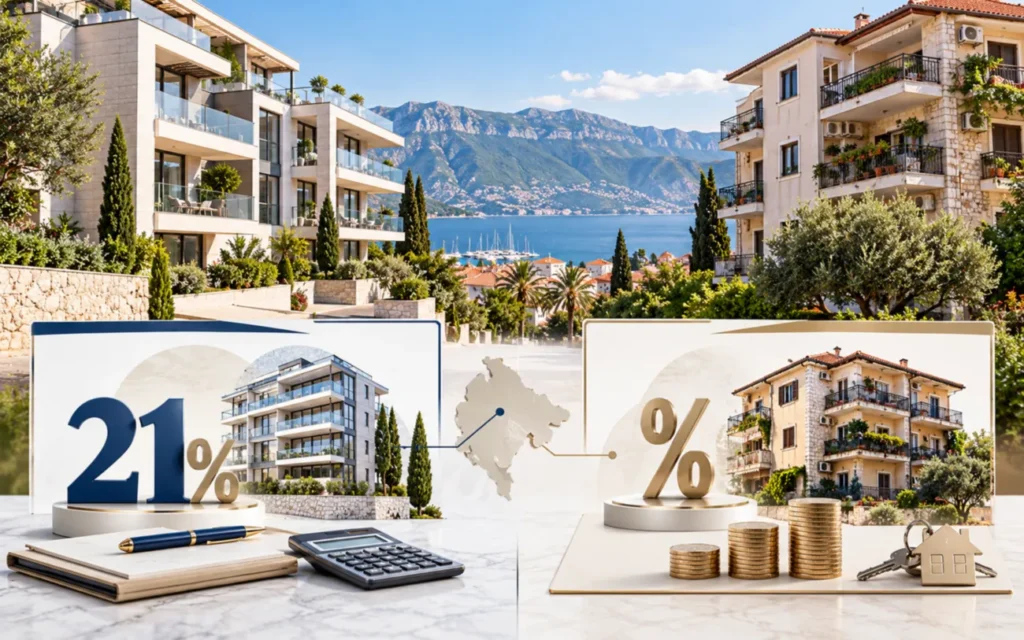
Note that the column for new builds says “where the transaction qualifies.” Not every apartment in a recently completed building is automatically sold under a VAT-taxable regime. Whether VAT or transfer tax applies depends on the nature of the specific transaction, the seller’s tax status and the history of the property’s ownership — not solely on the building’s completion date.
The property’s age alone does not determine the tax. The legal nature of the sale matters.
That principle should guide every buyer’s due diligence before committing funds.
VAT on New-Build Property
VAT is charged on the supply of goods and services in Montenegro at a standard rate of 21%. In the context of residential property, it applies to qualifying sales of newly constructed apartments and houses where the seller is a VAT-registered business making a taxable supply — typically a developer selling directly to a buyer for the first time after construction.
When this applies, the transaction falls outside the scope of the standard real estate transfer tax. The buyer does not pay both. However, VAT is not automatically attached to every property sold by a company, and it is not automatically absent from every transaction between individuals.
When VAT Applies
A sale of residential property by a VAT-registered developer qualifies as a VAT-taxable supply when it is the first taxable sale of that property following construction. The developer must be registered for VAT purposes in Montenegro, the transaction must relate to a newly built unit, and the sale must constitute a taxable supply under the applicable VAT rules.
The 2026 VAT amendments, applicable to qualifying construction-land supplies from 1 April 2026, extended VAT treatment to construction land for which the relevant construction approval has been issued. Transitional rules apply to certain advance payments made before that date. This change affects specific land transactions and should not be read as universally altering the tax treatment of finished residential apartments. The VAT treatment of a specific apartment and any associated land must be checked separately with a qualified local adviser.
A previous transfer is an important indicator that the current sale may not qualify as a first VAT-taxable supply, but the chain of ownership alone does not automatically determine the tax treatment. The basis of each prior transfer, the seller’s VAT status and the documentary history of the unit all need to be assessed. Ask a local tax adviser to review the underlying transfer records before drawing conclusions about the applicable regime.
VAT-Inclusive Prices
Developer quotations may be VAT-inclusive or VAT-exclusive, and there is no universal standard across the market. Understanding this distinction matters because buyers who assume the wrong basis can either overestimate the purchase cost or be caught short when the full amount is invoiced.
Consider a developer quoting €242,000 for a new apartment. That price, if it is VAT-inclusive, breaks down as follows:
- Price excluding VAT: €200,000
- VAT at 21%: €42,000 (calculated as €242,000 × 21 ÷ 121)
- Total price payable: €242,000
The €42,000 is not an additional payment on top of €242,000. It is the tax component already within the stated figure. You are paying the developer €242,000 in total, of which €42,000 represents VAT.
If, on the other hand, a developer quotes a price excluding VAT, you must add 21% to arrive at the full amount due. A €200,000 ex-VAT price becomes €242,000 inclusive of tax.
Before signing any reservation agreement or purchase contract, ask the developer three questions:
- Is the quoted price inclusive or exclusive of VAT?
- Is this transaction subject to VAT at 21%?
- Can you provide written confirmation of the VAT treatment in the purchase agreement?
Written confirmation reduces the risk of misunderstandings about the agreed price and VAT position, but the contract and its tax treatment should still be reviewed independently before you sign.
For a more detailed treatment of VAT rules specific to new apartments, see “Montenegro New-Build Property VAT“.
Explore new-build apartments in Montenegro
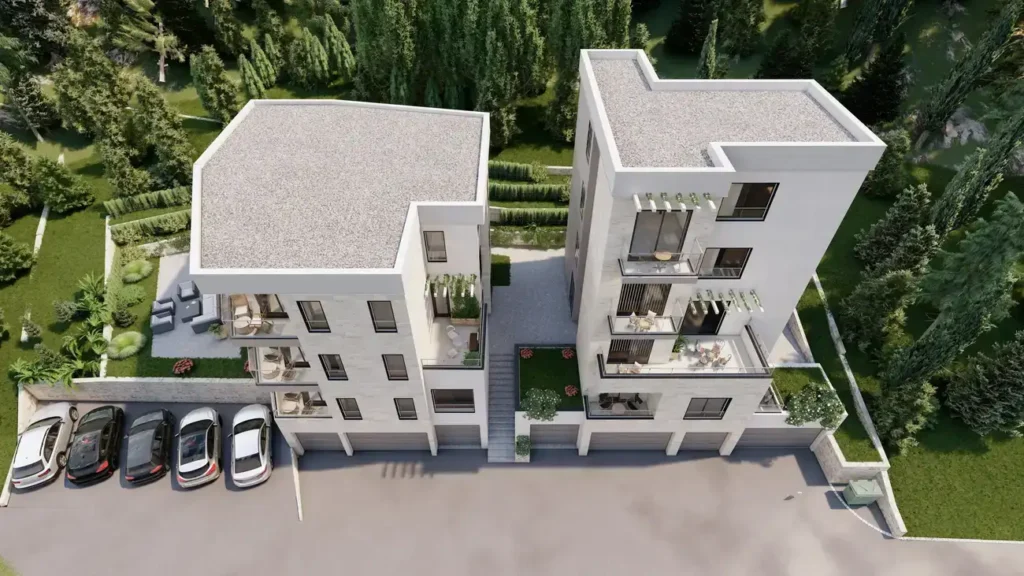

 Tivat
 от 42м²

 Kotorот 32.5м²


 Budvaот 38.52м²
Resale Property Transfer Tax
When you buy a property from an existing private owner — or from a company making a non-qualifying sale — the transaction is subject to real estate transfer tax (porez na promet nepokretnosti). This is a one-time tax generally triggered when the acquisition agreement is concluded, with specific timing rules for future properties and certain other transactions. In Montenegro it operates on a progressive scale introduced on 1 January 2024, as confirmed by the Montenegro Tax Administration. The statutory filing and payment deadlines are explained below.
For an ordinary taxable purchase, the acquirer is the statutory taxpayer for real estate transfer tax. A contractual agreement between the parties about who bears the economic cost does not necessarily change the legal liability towards the tax authority. Confirm the applicable tax obligations in the purchase agreement and with a qualified local adviser.
Under the general rules, the buyer must calculate the transfer tax, submit the tax return to the competent local tax authority and pay the tax within 15 days of the tax obligation arising. For a contract involving future property — such as an off-plan purchase — the timing may differ, including where the obligation arises upon handover or taking possession. Confirm the applicable deadline with the relevant authority or your legal adviser.
Progressive Tax Brackets
The progressive brackets introduced on 1 January 2024 remain applicable. The legal framework was further amended in 2026 — refer to the Montenegro Tax Administration’s explanation of the 2024 reforms and the 2026 tax amendments for the current consolidated position. The rate structure in effect at the time of writing is as follows:
| Taxable value | Calculation |
|---|---|
| Up to €150,000 | 3% of taxable value |
| €150,000–€500,000 | €4,500 + 5% of amount above €150,000 |
| Above €500,000 | €22,000 + 6% of amount above €500,000 |
A critical point: the higher rates apply only to the portion of value that falls within each bracket, not to the entire purchase price. A buyer paying €300,000 for a resale apartment does not pay 6% on the full amount. The calculation works in stages.
Worked example for a €250,000 resale purchase:
- First €150,000 at 3%: €4,500 (flat)
- Remaining €100,000 at 5%: €5,000
- Total transfer tax: €9,500
This is a meaningfully different outcome from a flat application of the highest rate. Applying 6% to €250,000 would produce €15,000 — a figure that overstates the actual liability by €5,500.
The table below shows verified transfer tax amounts across typical purchase prices, assuming the transaction is taxable, the assessed value equals the stated price and no statutory exemption applies. Certain transfers may qualify for statutory exemptions under Articles 12–14 of Montenegro’s Real Estate Transfer Tax Law. The first-home exemption under Article 12 is subject to specific conditions, including Montenegrin citizenship, residence in Montenegro, first-time acquisition for housing needs and an eligible area of up to 20 m² per household member. Foreign buyers should not assume that this exemption applies to them. Other statutory exemptions must be assessed separately. Confirm eligibility before relying on these figures:
| Purchase price | Transfer tax |
|---|---|
| €100,000 | €3,000 |
| €150,000 | €4,500 |
| €200,000 | €7,000 |
| €250,000 | €9,500 |
| €300,000 | €12,000 |
| €400,000 | €17,000 |
| €500,000 | €22,000 |
| €600,000 | €28,000 |
Taxable Market Value
Transfer tax is determined by reference to the legally established market-value tax base, which may differ from the consideration stated in the contract. The tax authority applies its own assessment methodology, and buyers should not rely on a low contract price to reduce the tax bill — an undervalued transaction can create additional obligations and complications. Confirm the assessed base and any available review procedures with the competent local tax authority before completing the purchase.
If the tax authority issues a valuation that you believe is incorrect, there is a formal process to challenge it. Your legal adviser should be involved in that process.
For a full explanation of the transfer tax rules and their practical implications, see “Montenegro property taxes“.
Real Purchase Cost Examples
The most practical question a buyer asks is straightforward: given the same advertised price, how much more does a resale apartment actually cost compared with a new build?
The table below illustrates that comparison. All new-build prices are treated as VAT-inclusive (the VAT has already been included by the developer in the stated figure). All resale figures show the transfer tax calculated on the assumption that the purchase price matches the taxable value.

| Advertised price | New build (VAT-inclusive) | Resale transfer tax | Resale: total price + tax |
|---|---|---|---|
| €150,000 | €150,000 | €4,500 | €154,500 |
| €250,000 | €250,000 | €9,500 | €259,500 |
| €400,000 | €400,000 | €17,000 | €417,000 |
| €600,000 | €600,000 | €28,000 | €628,000 |
How much cash do you need for a €250,000 apartment?
| Cost item | New build | Resale |
|---|---|---|
| Agreed property price | €250,000 | €250,000 |
| VAT | Included, if agreed and applicable | Not applicable in this private-resale example |
| Real estate transfer tax | €0 | €9,500 |
| Property price plus purchase tax | €250,000 | €259,500 |
| Notary | Additional | Additional |
| Lawyer and legal review | Additional | Additional |
| Cadastre registration | Additional | Additional |
| Translation and banking | If required | If required |
| Renovation or furnishing | Property-specific | Property-specific |
Minimum price-plus-tax budget: €250,000 for the qualifying VAT-inclusive new build, versus €259,500 for the taxable resale. These are not all-inclusive closing totals. Obtain written quotes for notarial, legal, registration, banking and furnishing expenses before committing funds.
Assumptions underlying this table:
- New-build prices include 21% VAT already within the quoted figure
- Each new-build transaction qualifies as a VAT-taxable developer supply
- Resale taxable values match the stated purchase prices
- Each resale transaction is taxable; no statutory exemption applies
- Notary fees, legal costs, cadastral registration and agency fees are excluded
- These are illustrative examples only, not real market offers
The gap between a new build and resale at €250,000 is €9,500 before any other costs. At €600,000 it reaches €28,000. These are not trivial sums, and they shift meaningfully once you fold in condition, fit-out and transaction-specific factors.
Scenario A: A buyer is comparing a new two-bedroom apartment in Tivat at €280,000 (VAT-inclusive, developer sale) with a similar resale apartment offered at the same price. At an assessed resale value of €280,000, transfer tax would be €11,000 (€4,500 + 5% × €130,000). If the resale apartment is instead priced at €265,000, its transfer tax would be €10,250 (€4,500 + 5% × €115,000), bringing the illustrative total to €275,250 — €4,750 below the €280,000 VAT-inclusive new build, before other expenses. That gap is real, but it narrows considerably against the original comparison and should be weighed alongside condition, fit-out and transaction complexity.
Scenario B: A buyer finds a resale flat €15,000 below a comparable new build. The resale transfer tax on €235,000 would be approximately €8,750, leaving a net saving of roughly €6,250. If the resale property hypothetically requires €10,000–€15,000 of work before it is rent-ready, the financial advantage evaporates — renovation costs vary widely and must be estimated from actual inspection, not assumed. A lower acquisition tax does not necessarily mean a lower overall cost of ownership. Purchase price, applicable taxes, renovation requirements and other transaction-specific expenses must all be considered before drawing a conclusion about which option represents better value.
Other Property Purchase Costs
Transfer tax or VAT is the most significant variable between transaction types, but it is not the only cost you will pay on the way to registration. Both new builds and resale properties carry additional closing costs, and some vary by transaction complexity and the specific professionals you engage.
| Expense | New build | Resale | What to verify |
|---|---|---|---|
| Notary fees | Required for purchase agreement | Required for purchase agreement | Set by tariff; confirm with your notary |
| Cadastral registration | Required to register ownership | Required to register ownership | Administrative charges depend on the applicable fee schedule and filing type; verify with the cadastre or your notary |
| Legal review | Recommended; cost varies | Recommended; strongly advised | Check what is included in the scope |
| Interpreter / translation | A qualified court interpreter may be required if a party does not understand the language used in notarial proceedings | A qualified court interpreter may be required if a party does not understand the language used in notarial proceedings | Written certified translations depend on the documents and the notary’s requirements; confirm scope in advance |
| Bank transfer / currency conversion | Depends on your bank and payment method | Depends on your bank and payment method | Confirm exchange rate and fees in advance |
| Agency fee | If payable under contract | If payable under contract | Confirm who pays and when |
| Fit-out or renovation | Often required for unfinished new builds | Condition-dependent | Budget separately before comparing total cost |
| Mortgage costs | If financing | If financing | Arrangement fees and insurance vary by lender |
Notary fees under the 2026 tariff
Montenegro introduced a new notarial fee tariff on 9 April 2026. For a notarial deed valued at €250,000, the standard value-based fee under tariff item 1 is approximately €597 before VAT, or €722.37 including 21% VAT. Additional notarial actions, copies, filing fees or disbursements may increase the final invoice. The exact fee also depends on the form of the notarial act, so request a written quotation from the notary.
Taxes, administrative registration fees and regulated notarial charges are separate categories of acquisition cost and should be distinguished from privately agreed fees for legal representation, banking and other services. Do not conflate them when building your budget. Independent legal advice is strongly recommended, particularly for foreign buyers, although engaging a separate lawyer is not generally a statutory requirement for an ordinary property purchase.
For new apartments sold off-plan or in stages, payment schedules can affect when VAT is effectively recognised and when the property is formally registered. Confirm the ownership transfer mechanics in the preliminary contract before making staged payments.
How should a foreign buyer pay for the property?
Before transferring a deposit or the purchase balance, confirm the permitted payment route with your Montenegrin bank, notary and independent legal adviser. Anti-money-laundering rules restrict qualifying cash transactions of €10,000 or more, including certain linked payments. Banks and notaries may also request documentation identifying the buyer, the source of funds and the purpose of the transaction. Check transfer limits, settlement timing, possible intermediary-bank charges and any agreed escrow or notarial-account arrangements before the payment date.
A full walkthrough of the purchasing process is available at “How to buy property in Montenegro“.
Know your purchase budget — but not which apartment fits?
Compare properties in Montenegro based on location, budget and purchase goals. The Residence can help you shortlist options for a closer review of taxes and closing costs.
Find properties within your budget
When a New Property Is Resale
One of the most common sources of confusion among foreign buyers is the assumption that a brand-new apartment is automatically a VAT transaction. It is not. The tax treatment follows the legal nature of the sale, not the age or condition of the building.
Three situations illustrate the difference:
1. Developer sale of a newly built apartment. The developer, registered for VAT, sells a unit directly to the buyer in what constitutes the first taxable supply following construction. This is the classic VAT scenario — assuming all conditions are met, VAT at 21% applies and transfer tax does not.
2. Private resale of a recently completed apartment. A buyer purchased a new apartment from a developer in 2025. In 2026 they decide to sell. The building is one year old. The flat looks new, is finished to a modern standard and may even retain its original kitchen appliances. None of that changes the tax treatment. This is a resale transaction between two private parties. The first taxable VAT supply has already occurred. The 2026 sale would generally fall within the real estate transfer tax regime, with the applicable amount calculated under the progressive scale unless a statutory exemption applies. In the absence of an exemption, the buyer pays transfer tax, not VAT.
3. Sale by a company that is not a developer. A corporate entity selling property it has owned and used — or purchased as an investment — may not be making a qualifying VAT supply even if the property is relatively new. The company’s VAT registration, the nature of its activity and the tax history of the specific unit all affect the outcome. Do not assume that “sold by a company” means “subject to VAT.”
A recently completed apartment is not necessarily a first-sale property for tax purposes.
The marketing description “brand-new apartment” carries no legal weight for tax purposes. What matters is the documented chain of ownership and whether a VAT-taxable sale has previously occurred.
Before signing, ask the selling agent or seller directly: has this property been sold before, and if so, was that sale subject to VAT? A qualified local adviser should review the cadastral ownership history alongside the underlying contracts, invoices and relevant tax documentation. The cadastre alone cannot establish whether a previous transfer was subject to VAT or determine the correct tax treatment of the current sale.
What should you check before buying?
| Check | New build / off-plan | Resale |
|---|---|---|
| Legal seller | Verify developer identity and authority | Verify registered owner and authority to sell |
| Planning and permits | Review construction and occupancy documentation where applicable | Check legality of the building and later alterations |
| Ownership registration | Confirm how and when the unit will be registered | Obtain a recent cadastral extract |
| Payment risk | Review milestones, delays, termination and refunds | Check payment and release conditions |
| Physical condition | Inspect finishes and specifications at handover | Inspect the actual property and building |
| Building expenses | Request projected management charges | Request actual service-charge history and arrears information |
| Tax treatment | Confirm whether the sale qualifies for VAT | Confirm transfer-tax treatment and exemptions |
A completed new apartment and an off-plan apartment involve different risks, even when both are sold by the same developer. A lower acquisition tax does not replace legal, technical or financial due diligence.
How to Verify the Tax Treatment
Establishing the correct tax treatment before you commit funds is not bureaucratic caution — it is financial due diligence. The following steps apply whether you are buying a new build or a resale property.

1. Identify the legal seller. Confirm whether the seller is an individual, a developer, a company or another entity. The seller’s legal and tax status is the starting point for determining which tax regime applies. Ask for the seller’s company registration number if applicable.
2. Confirm ownership in the cadastre (list nepokretnosti). The list nepokretnosti is Montenegro’s official property ownership record. Obtain a current extract to check the registered owner, recorded rights and encumbrances. Note that a current extract alone is not a complete title investigation — request additional historical records and supporting documents where necessary, and have your legal adviser review them.
3. Establish whether the transaction is subject to VAT. Ask the seller or their representative directly: is this sale subject to VAT at 21%? If the answer is yes, follow up with question 4. If the transaction is not subject to VAT, assess whether real estate transfer tax applies and whether any statutory exclusion or exemption — such as certain first-home acquisitions — is available before calculating the expected amount.
4. Obtain written confirmation of VAT-inclusive or VAT-exclusive pricing. Do not rely on verbal assurances. The purchase agreement should state clearly whether the price is VAT-inclusive or VAT-exclusive. If the developer quotes an ex-VAT price, calculate the full inclusive amount before comparing it with resale options.
5. Review the ownership history. Confirm whether a previous transfer of this specific unit has taken place. A prior transfer is an important indicator, but it does not by itself establish the VAT treatment — the basis of the earlier transfer, the seller’s VAT status and the documentary record must all be assessed by a local tax adviser before drawing conclusions.
6. Check the relevant property documentation. Review the building permit, occupancy certificate (upotrebna dozvola) and any relevant planning approvals. Unauthorised additions, unregistered structures or outstanding issues with legality can create complications that affect both the transaction’s validity and the applicable tax.
7. Request an estimate of transfer tax, if applicable. Using the progressive brackets, calculate the expected transfer tax based on the agreed purchase price. Ask your legal adviser whether the taxable value is likely to differ from the contract price — in some cases the tax authority may apply a different assessed value.
8. Ask an independent local adviser to verify the contract’s tax provisions. A notary formalises the transaction, but a notary’s role is not to give you independent tax or legal advice. Engage a local lawyer — ideally one with property transaction experience — to review the contract, confirm the tax treatment and flag any provisions that require clarification before signing.
From reservation to tax payment: the buyer’s timeline
| Stage | Action |
|---|---|
| Before reservation | Confirm ownership, seller identity, project legality and tax treatment |
| Before significant deposit | Review the preliminary agreement, refund conditions and payment plan |
| Before signing | Receive final VAT or transfer-tax clarification and closing-cost estimates |
| Contract signing | Execute the required notarial documentation and follow the agreed payment process |
| Tax obligation arises | Determine whether transfer tax is payable and when the statutory deadline starts |
| Within the applicable deadline | Submit the transfer-tax return and pay the amount due, where required |
| Ownership registration | Confirm that the cadastral registration has been completed |
| After acquisition | Check the municipality’s annual property-tax procedures |
For ordinary taxable transfers, the general declaration and payment deadline is 15 days from the moment the tax obligation arises. Special rules may apply to future properties and other non-standard transactions.
Notarial execution does not guarantee that all tax obligations are correctly identified in the contract. Your legal protection comes from thorough pre-signing review, not from the formality of the notarisation itself.
For a comprehensive checklist of pre-purchase steps, see “Montenegro real estate due diligence“.
Not sure whether a new build or resale is right for you?
Start with properties that match your budget and purpose. Then compare the seller’s documentation, applicable taxes and purchase conditions before committing funds.
Get a personalised property shortlist
Taxes After Buying Property
Transfer tax or VAT is a one-time payment due at the point of acquisition. It does not represent the full extent of your tax obligations as a property owner in Montenegro.
Annual property tax (porez na nepokretnosti) applies to all property owners in Montenegro, including foreign nationals. The tax is levied by the relevant municipality and calculated on the assessed value of the property. Rates and assessed values vary by municipality, property type and location. Importantly, buying a new build does not exempt you from annual property tax — the liability is generally assessed by reference to ownership as at 1 January of the tax year. Buyers should confirm the notification and payment requirements with the relevant municipality after registration.
Annual property tax: an illustrative calculation
| Assessed property value | At 0.25% | At 0.50% | At 1.00% |
|---|---|---|---|
| €150,000 | €375 | €750 | €1,500 |
| €250,000 | €625 | €1,250 | €2,500 |
| €400,000 | €1,000 | €2,000 | €4,000 |
These are mathematical examples using the general 0.25%–1% range, not quotations for a particular municipality. Secondary residences and certain other property categories can be subject to different rates. The actual bill depends on municipal rules, property classification, assessed value and any applicable adjustments.
A holiday apartment may be classified as a secondary residential property rather than a main residence. Montenegro’s property-tax framework allows different treatment for certain secondary homes, and municipalities set the applicable parameters. Before buying a holiday home, request the latest property-tax assessment for that specific unit and confirm whether the classification is expected to change after the purchase.
Municipalities such as Budva, Tivat, Kotor and Bar each set their own assessment parameters within the national framework, so the annual cost for a comparable property can differ depending on location.
If you intend to let the property, rental income tax applies to income earned from tenants. The applicable rate and reporting requirements depend on your tax residency status and the rental arrangement. This is a separate regime from the purchase taxes covered in this article, and it requires its own planning.
If you later sell the property at a gain, capital gains tax may apply. The taxable gain, applicable rate, deductions and any exemptions should be checked under the income-tax rules in force at the time of disposal; do not assume the rate changes with the holding period.
Understanding these ongoing obligations before purchase helps you model the true cost of ownership rather than focusing solely on the acquisition taxes.
Which Option Makes More Sense?
A lower transfer tax does not automatically make a new build the better purchase. Similarly, a higher apparent tax burden on a resale property does not make it the wrong choice. The right decision depends on your individual profile, budget and purpose.
| Montenegro | €2,557 |
| Coastal region | €2,838 |
| Podgorica | €2,510 |
| Central region | €2,131 |
| Northern region | €2,145 |
MONSTAT reported an average price of €2,557 per square metre for newly sold dwellings nationwide in Q2 2026, compared with €2,838 in the coastal region. These figures cover qualifying first-market transactions only and cannot be used as direct resale-price benchmarks. Buyers should compare similar properties in the same neighbourhood, with matching size, condition, completion status and amenities.
Buyer A: Budget-focused buyer This buyer is optimising for the lowest total amount spent at and after acquisition. The correct comparison is not “VAT versus transfer tax” in isolation — it is total acquisition cost including purchase price, applicable tax, fit-out, legal fees and early maintenance. A resale apartment priced €20,000 below a comparable new build may still be the cheaper option even after transfer tax, particularly if it requires little renovation. Run the full numbers before concluding that a new build saves money.
Buyer B: Holiday-home buyer Buyers purchasing in Kotor, Budva or Herceg Novi for personal use often prioritise building quality, communal facilities, proximity to amenities and the availability of the property from day one. A new build sold off-plan requires patience and carries construction risk. A resale property in an established building offers immediate access but may carry higher maintenance costs if the building is older. The tax difference is real but may be secondary to practical considerations about how and when you will use the property.
Buyer C: Rental investor An investor comparing properties in Tivat or Bar needs to weigh total acquisition cost against projected rental income and ongoing expenses. A new build may have lower initial maintenance requirements, while a resale unit may require additional preparation before letting. Compare net returns using documented rental assumptions, realistic vacancy rates, management fees and refurbishment costs — neither property type should be assumed to outperform the other without a properly modelled comparison. The transfer tax on a €300,000 resale is €12,000 — a figure that should be built into the investment model as part of the total cost basis, not treated as a surprise after the fact.
Geography influences market prices but does not alter the national transfer tax scale. The brackets apply uniformly across Montenegro regardless of whether the property is in Podgorica, Bar or a coastal municipality.
Looking for the right property in Montenegro? The Residence can help you compare new-build and resale options based on your budget, preferred location and purchase requirements. Find properties that match your needs.
Common Property Tax Mistakes
Errors in tax planning at the purchase stage can result in unexpected costs, delays and — in some cases — disputes with the tax authority. The following mistakes appear regularly in transactions involving foreign buyers.
1. Using the old flat rate of 3% for all resale transactions. Before January 2024, transfer tax in Montenegro operated at a flat 3%. That rate no longer applies universally. The current progressive structure means that transactions above €150,000 attract higher effective rates. Budgeting only 3% on a €400,000 resale purchase understates the tax by €5,000: the correct amount under the progressive scale is €17,000 rather than €12,000.
2. Applying the 6% rate to the full purchase price. The 6% rate applies only to the portion of value exceeding €500,000. Applying it to the entire purchase price of a €600,000 property would produce a tax of €36,000 — nearly €8,000 more than the correct figure of €28,000.
3. Assuming that any new or newly-built property is automatically exempt from transfer tax. As explained above, a recently completed apartment sold by a private owner is subject to transfer tax, not VAT. The building’s completion date does not determine the tax; the legal nature of the sale does.
4. Adding VAT on top of a price that already includes it. If a developer quotes a VAT-inclusive price of €242,000 and you then add a further 21%, you will budget €292,820 for a property that costs €242,000. Confirm whether the stated price is inclusive or exclusive of VAT before building your budget.
5. Ignoring the taxable market value. The tax authority may assess a higher value than the contract price, particularly in areas where declared prices are known to differ from market values. Budget conservatively and confirm the likely taxable value with your adviser before exchange.
6. Comparing advertised prices without accounting for total acquisition cost. Two properties with the same headline price can have meaningfully different costs once tax, legal fees, fit-out and registration are included. Build a full cost model for each option — not just the asking price — before deciding which represents better value.
For a broader set of pitfalls in the Montenegrin market, see “Mistakes buying property in Montenegro“.
Final Buying Checklist
Before committing to any property purchase in Montenegro — new build or resale — confirm the following:
- Identify the transaction type. Establish whether you are buying from a VAT-registered developer in a qualifying first sale, or from a private seller in a transfer-tax transaction.
- Verify VAT in the price. If the seller is a developer, confirm in writing whether the quoted price is VAT-inclusive or exclusive. Adjust your budget accordingly.
- Calculate the expected transfer tax. If transfer tax applies, use the progressive brackets to estimate the amount and confirm the likely taxable value.
- Include all closing costs. Add notary fees, cadastral registration, legal fees, translation costs and any agency fees to your total acquisition budget.
- Review the cadastre entry. Obtain a current list nepokretnosti and check for encumbrances, disputed ownership or unregistered changes.
- Check the property’s ownership history. Review previous transfers and any available VAT documentation. These records help establish the transaction’s tax treatment, but a previous sale alone does not conclusively determine whether VAT or real estate transfer tax applies — the underlying contracts and tax position of each transfer must be assessed.
- Compare total acquisition cost. Do not compare advertised prices alone. Build a complete cost model for each option you are considering.
- Get professional sign-off before any significant deposit. An independent local lawyer — not just a notary or the seller’s agent — should review the contract and confirm the tax treatment before you commit funds you cannot easily recover.
The tax difference between a new build and a resale in Montenegro is real, quantifiable and in many cases significant. Understanding it before you search, not after you have chosen a property, puts you in a position to compare options accurately and negotiate from a position of knowledge.
This article provides general information about property taxation in Montenegro and does not constitute legal or tax advice. Tax rules can change and individual transactions may be treated differently depending on their specific legal structure. Buyers should confirm the treatment of their specific transaction with a qualified local professional before proceeding.
 Real estate in Georgia
 Real estate in Cyprus
 Real estate in the UAE
 Real estate in Bali
 Real estate in Thailand
 Real estate in Spain
 Real estate in Saudi Arabia
 Real estate in Turkey
 Real estate in Zanzibar
 +382 60 099359
 hello@residence-estate.me
 The Old Bakery Residences, Budva 85310, Montenegro



 Get catalogue of TOP-7 objects